
HVAC service for a city with a century of houses
A Willo bungalow and a Desert Ridge two-story share a climate and nothing else. We start with the house you actually own.
- Rooftop and ground systems
- Older duct systems
- Flat-rate price first
- 24/7 emergency service
Schedule today — we’re here 24/7.
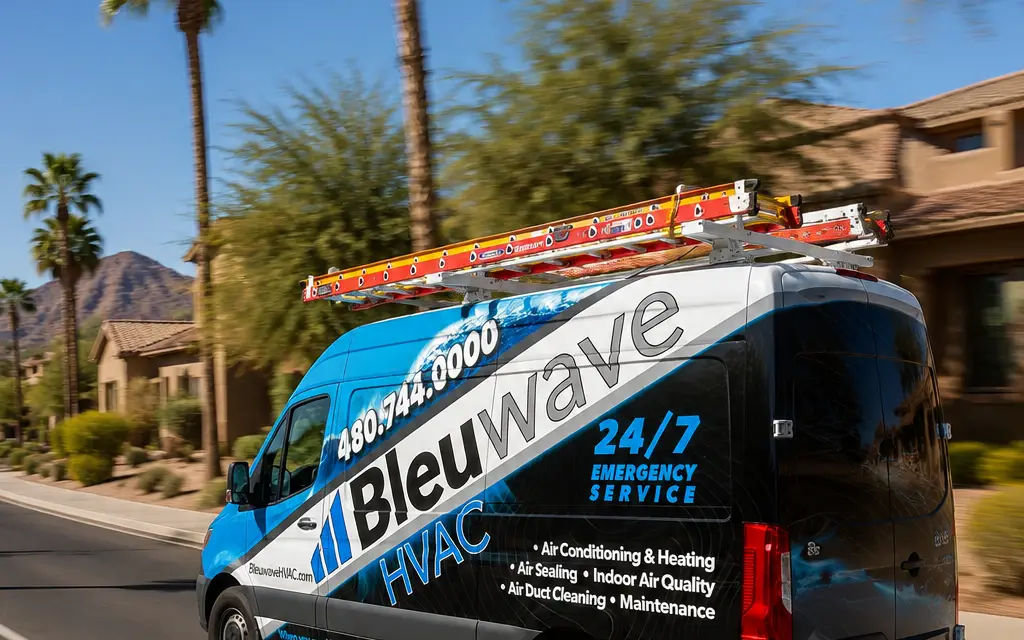
Phoenix is not one housing market. It is several, stacked on top of each other like the layers in a road cut. The city has been building since the 1880s and has never stopped, which means your neighbor's air conditioner may be solving a different problem than yours.
The median home here dates to 1985, and 42% went up before 1980. That house has outlived several air conditioners and probably a roof or two. Nobody can tell you what yours needs from a truck window, and anybody who tries is selling something. Bleuwave sends a NATE-certified technician who measures first and hands you a flat price before a wrench comes out.
- 1985
- Median home built
- 60%
- Single-family detached
- 57%
- Owner-occupied
- $420,700
- Median home value
A city built in every decade
No decade dominates, which is the point. 74% of occupied homes heat with electricity and 23% with natural gas, so a Phoenix technician should be equally at home with a heat pump and a gas furnace. About 32% of housing units sit in apartment or multi-unit buildings, and 43% of households rent, which makes landlord maintenance a real part of the local trade.
When the homes were built
What heats them
- 74% electricity
- 23% natural gas
- 1% propane
- 2% other or none
U.S. Census Bureau, American Community Survey 2020–2024, 5-year estimates. Estimates carry a margin of error, wider in small communities. Electric heat includes both heat pumps and electric furnaces; the Census doesn’t separate them.
What Phoenix homes ask of an HVAC system
Rooftop units on older homes
Many older ranch houses cool from a package unit on the roof. It takes direct sun all summer and dust all monsoon season, and the roof curb seal matters as much as the compressor. A tune-up should include a look at both.
Ducts older than the owner's mortgage
A house from the 1950s or 1960s may still move air through its first ducts, or through a patchwork of later repairs. If the bill keeps climbing while the rooms stay warm, test the ducts before you buy a bigger machine.
Refrigerant that's left the market
Equipment built around R-22 needs a refrigerant the U.S. stopped producing and importing in 2020. Repairs get expensive fast. Our refrigerant guide explains when to keep spending and when to stop.
From the historic districts to the north edge
Willo and Encanto-Palmcroft
Historic districts with homes from the early twentieth century, built before central air existed. Ducts had to be fitted in later, often awkwardly. Ductless mini-splits or a high-velocity system can spare the plaster.
Arcadia
Citrus groves turned into mid-century ranch homes on big lots, many since remodeled or rebuilt. An addition often inherits ducts sized for the smaller house it grew from, so one end of the home stays warm.
Maryvale
Known for the affordable tract homes that spread west after World War II. On houses of that age, roof condition, insulation and duct leaks often decide whether a new unit pays off.
Desert Ridge and north Phoenix
Newer master-planned neighborhoods with two-story floor plans and attic air handlers. The usual complaint is an upstairs that never catches up, which is an airflow question before it's an equipment one.
Should you repair or replace a system that came with the house?
Buy an older Phoenix home and you inherit a stranger's maintenance habits. Start with the data plate on the outdoor unit: the serial number usually gives the year, and the label names the refrigerant.
If it's R-22 and past its prime, a big repair is a poor bet. If it's newer and simply neglected, a $129 tune-up may buy years. Our honest math on repair versus replace walks through the numbers.
Before you call anyone
- Read the refrigerant type off the data plate
- Note whether the unit sits on the roof or the ground
- Find the last service sticker, if any
- List the rooms that never get comfortable
What Phoenix customers say
Bleuwave came out today for our AC tune up that we typically have done every six months just to be sure everything is working properly. Adrian was our tech and he was super nice and professional! All of our needs were met and questions were answered. We love Bleuwave and have been using them for 3 years now. Whenever we have an issue with our home that we do not feel confident handling on our own, we call Bleuwave.
Excellent work. Knew the problem right when I explained what was going on. Thanks
What a new system costs in Phoenix
Phoenix replacements swing on access more than geography. A rooftop package unit can need a crane or a curb adapter. A ground-mounted split usually doesn't. An older home may need new ducts or an electrical upgrade to do the job properly, and a good quote says so in writing instead of finding it on install day.
We charge the same way across the Valley: a flat-rate price before any work starts. Our $129 tune-up, $50 off any repair and 0% financing on approved credit apply in Phoenixas they do everywhere else. The estimator gives you a range in about a minute. It isn’t a quote, because nobody has seen your attic yet.
Step 1 of 3
How big is your home?
Power bills and rebates in Phoenix
Phoenix is split between APS and SRP, and the boundary can run down a single street. Your bill settles it.
SRP lists rebates of up to $1,125 on a new energy-efficient AC, up to $400 for duct testing and repair, and up to $600 for insulation, plus up to $100 for enrolling a smart thermostat. It accepts claims on work finished within the past six months. Check SRP's current terms before you count on the money.
APS is a different story. In December 2025, the Arizona Corporation Commission zeroed out the budget for its residential home-improvement incentives, effective January 1, 2026. The Cool Rewards program, which pays customers to let APS nudge a smart thermostat during peak demand, survived.
One thing to cross off the list: the federal energy efficient home improvement credit covers improvements made through December 31, 2025. A system installed today doesn't qualify, whatever an old flyer says.
Programs checked November 2026. They change, so confirm before you buy.
Permits for HVAC work in Phoenix
Work inside city limits falls under Phoenix Planning and Development. What needs a permit depends on the scope, and historic districts can add their own review for anything visible from the street. We'd rather send you to the source than quote a rule from memory.
City of Phoenix Planning and DevelopmentWhoever does the work should hold an Arizona Registrar of Contractors license. Bleuwave’s is ROC #340022, and you can look any contractor up at roc.az.gov.
Where Phoenix homeowners usually start
Phoenix service guides
This month's specials
Book online to claim. Stack with 0% financing on approved credit.
Phoenix HVAC questions
Straight answers, no runaround. Don’t see yours? Our team is a phone call away, around the clock.
Often, yes, but it's a real project: new refrigerant lines, a new air handler location, and ductwork changes. It can make sense on a roof near the end of its life. We'll price both ways so you can compare.
It's often the gentlest option. A mini-split needs only a small hole through the wall rather than duct chases through old plaster. Check with the city first if your home is in a historic district and the outdoor unit would be visible.
The Census puts the median year built at 1985, and 42% of homes predate 1980. That's old enough that many have been through several systems, so the house's age and the equipment's age are separate questions.
Yes. About 43% of Phoenix households rent, and landlords need a clear written scope and honest repair-or-replace advice. See our notes on property management HVAC.
We run same-day service across the Valley and answer 24/7, because a dead air conditioner in July isn't an inconvenience. Call (480) 863-5855 and a real person picks up.
Sources
- U.S. Census Bureau, American Community Survey 2020–2024 (Phoenix)
- Wikipedia, Phoenix, Arizona
- APS, service area maps
- SRP, street atlas maps
- City of Phoenix Planning and Development
- SRP, residential rebates
- Arizona Corporation Commission, December 3, 2025 meeting highlights
- KJZZ, regulators scale back APS efficiency incentives
- IRS, Energy Efficient Home Improvement Credit
Page updated 2026-11-07. Written for homeowners; every home still needs its own look before anyone quotes it.
Book HVAC service in Phoenix
Book online or call now — same-day appointments available across the Valley.
- 24/7 emergency service
- Upfront, honest pricing
- Licensed, bonded & insured