
Indoor Air Quality Guide for Desert Homes
Dust, haboobs, leaky attic returns and six weeks of monsoon humidity: what actually affects the air inside a Phoenix house, and which fixes address the source rather than the symptom.
- Where haboob dust really gets in
- MERV explained, without the hype
- When a high-MERV filter hurts airflow
- What UV and ionizers can honestly claim
Schedule today — we’re here 24/7.
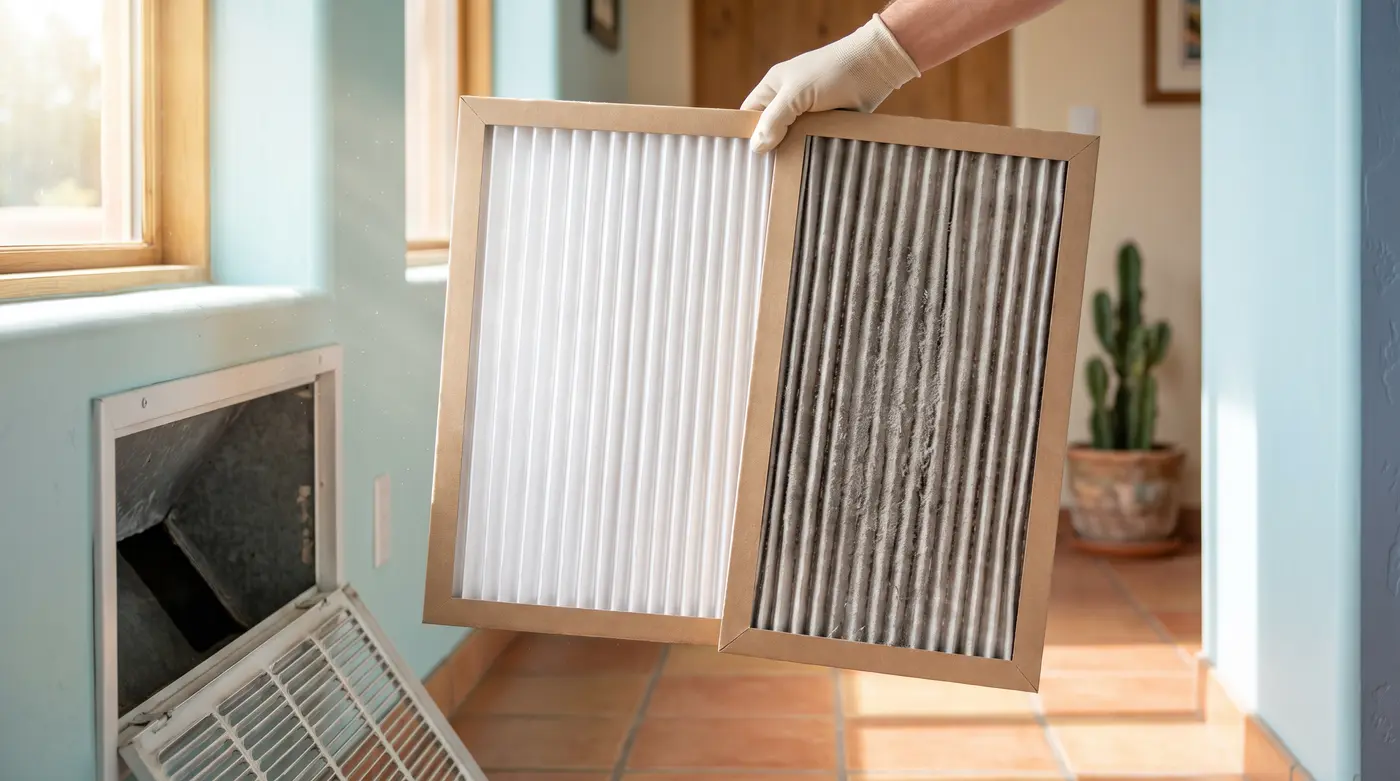
Air quality in a desert house is mostly a dust problem
Phoenix air quality has a specific character. It is dust, most of the year, and then six weeks of monsoon humidity that catches everyone by surprise. A haboob rolls in off the desert, the sky goes brown, and a week later there is a fine gray film on the bookshelf. The question is how it got inside. The honest answer is that most of it did not come through the windows. It came through the air handler.Where the dust actually enters
Every forced-air system in the Valley is a pump. It pulls air in through the return grille, pushes it across a coil, and sends it back out through the supply registers. If the return duct leaks in the attic, the system pulls attic air instead of room air. Attic air at 155 degrees carries insulation fibers and drywall dust. This is why filtration alone rarely fixes a dusty house. The filter sits downstream of the leak, catches some of what passes, and loads up in three weeks. Sealing the return side closes the door the dust is walking through. Other entry points, in rough order of importance:- An unsealed filter slot at the air handler, which lets air bypass the filter entirely
- Gaps around the return grille frame
- Open windows during a dust advisory
MERV ratings, and when a higher number hurts
MERV is a scale from 1 to 16 that describes how well a filter captures particles of a given size in a laboratory test. A higher number captures smaller particles. The scale says nothing about how much air the filter allows through, and that is where Phoenix homes get into trouble. Most block-and-stucco tract homes were built with one return, sized for a cheap fiberglass filter that barely slows the air. Drop a dense one-inch MERV 13 pleated filter into that slot and the blower now has to pull air through a wall. Static pressure rises. Airflow across the coil falls. The coil runs colder than designed and, in July, can freeze into a block of ice. A higher MERV number is not a better filter if the system cannot breathe through it.The media cabinet fix
The way out of the tradeoff is surface area. A media cabinet holds a four- or five-inch pleated filter with several times the surface area of a one-inch filter, so it can capture finer particles while letting more air through. A static pressure test before and after tells you whether the change helped or hurt. We also look at whether the return itself is undersized, which is common, and whether a second return would do more than any filter.Ventilation and the monsoon problem
For most of the year the desert air is dry enough that humidity control means nothing. Then July arrives, dew points climb, and a house that has been sealed tight for efficiency holds moisture the way it held dust. Evaporative coolers, which add water to the air by design, are the wrong tool during monsoon and a fine one in May and October. Our evaporative cooler page explains why they get switched off when the humidity comes. Mechanical ventilation, an energy-recovery ventilator for instance, brings in a controlled amount of outdoor air and tempers it with the air going out. Whole-home dehumidifiers exist and work, but the season that would justify one is short. We tell most homeowners to run the air conditioner, keep the fan on auto rather than on, and wait for September.UV lamps, ionizers and what may honestly be said about them
We will stick to mechanics here. A UV lamp mounted at the coil shines ultraviolet light on the coil surface and drain pan. Its function is to keep those wet, dark surfaces from developing the film that builds up on them over a season. That is a maintenance benefit for the coil, and it is the claim that can be supported. A needlepoint ionizer adds an electrical charge to particles passing through the duct so that they clump together and are easier for the filter to catch. Its usefulness depends entirely on the filter downstream. A polarized-media or electronic air cleaner does its own capturing and needs periodic cleaning to keep working. We describe what these devices do to particles and surfaces. We do not make claims about what they do for people, and neither should anyone selling them. If a dusty house is the complaint, spend the money on duct sealing and a media cabinet first. Those two changes address the source. Add-on devices address the symptom.What an air-quality visit covers
A web page cannot tell you why your house is dusty. On an air-quality visit we measure static pressure at the air handler, inspect the filter slot and return plenum for bypass, check the coil for buildup, and run a duct leakage test when the readings suggest the returns are pulling attic air. You get the numbers, a plain explanation of what they mean, and a flat-rate price before any work begins. Sometimes the answer is a different filter and nothing else. Financing on approved credit exists for the larger projects, and our maintenance guide explains how a tune-up keeps the coil and drain in shape between visits.When to call
Call when dust streaks appear around supply registers, when a filter that used to last three months loads up in three weeks, when a musty odor follows the first monsoon storm, or when the coil freezes after a filter change. If the air handler is old enough that a coil cleaning turns into a coil replacement, the repair-versus-replace guide lays out the math without the pressure. Bleuwave answers 24/7 at (480) 863-5855, and an on-site evaluation is the only way to size a filter cabinet, find a leak, or confirm that the fix you are considering is the fix you need.Indoor Air Quality Guide for Desert Homes: common questions
Straight answers, no runaround. Don’t see yours? Our team is a phone call away, around the clock.
Only if the system can move enough air through it, and only if the dust is coming through the filter rather than around it. Most single-return tract homes cannot pull enough air through a dense one-inch filter without raising static pressure to a level that hurts cooling. Have static pressure measured before changing filter grades, and ask whether a media cabinet or a larger return makes more sense.
Rapid loading usually means the return side is pulling attic air through a leak, or the filter slot is letting air slip past the edges. A duct leakage test tells you which. Replacing the filter more often treats the symptom while the leak keeps feeding the house.
Rarely. Dry indoor air is the desert's default for most of the year. Whole-home humidifiers are sold for houses with hardwood floors or instruments that need stable moisture, which is a specific reason rather than a general one. Bring it up at the evaluation if you have that reason.
In a dry month a continuously running fan passes more air through the filter each day, at the cost of blower electricity. During monsoon it also re-evaporates moisture sitting on the cold coil and sends it back into the house. Auto is the better setting in July and August.
No. The lamp limits film on the surfaces it illuminates; it does not remove dust already packed into the fins, and its bulb has a replacement interval. An annual maintenance visit still needs to clean and inspect the coil.
Cleaning removes what is already inside the ducts. Sealing stops more from entering. If the return side leaks, cleaning alone becomes a repeat purchase, so we recommend testing for leakage before scheduling either.
Sometimes. A house that has been tightened with new windows, foam and weatherstripping may need controlled ventilation. Many older homes leak enough on their own that adding more outdoor air makes little difference. It is a measurement question, not a catalog question.
Ask for the number behind it: the static pressure reading, the leakage percentage, the coil condition. We quote flat-rate before work begins and we will say when the answer is a cheaper filter and nothing else. A recommendation that arrives without a measurement is a sales pitch.
Indoor Air Quality Evaluation throughout the Phoenix area
Same-day appointments across Maricopa and Pinal counties. Pick your city for local pricing pages, reviews and service details.
Find out where the dust is coming from
An on-site evaluation measures leakage and static pressure before anyone sells you a filter. Call (480) 863-5855 or request a visit.
- 24/7 emergency service
- Upfront, honest pricing
- Licensed, bonded & insured