
Why Isn't My Manufactured Home AC Cooling?
Manufactured homes fail in ways site-built homes do not: crossover ducts, belly board leaks, compact coils. Here are the safe checks and the causes a technician looks for.
- Ten-minute safe homeowner checks
- The crossover duct under the marriage line
- Belly board and under-floor duct leaks
- When undersized equipment is the real issue
Schedule today — we’re here 24/7.
Start with the checks that are safe to do yourself
A manufactured home that will not cool in July gets uncomfortable fast; there is little thermal mass to buy you time. Run through these first. They take ten minutes and cost nothing.- Thermostat: confirm it is set to Cool, the setpoint is below room temperature, and the fan is on Auto. Replace the batteries if the display is dim or blank.
- Filter: pull it and hold it to a light. If you cannot see through it, replace it.
- Breaker: check the panel for a tripped breaker on the AC or air handler. Reset it once. If it trips again, stop; something is wrong, and repeated resets can damage the equipment.
- Ice: look at the indoor coil housing and the refrigerant lines at the outdoor unit for frost. If you see any, turn the system off at the thermostat and let it thaw before anyone runs it again.
- Outdoor unit: clear weeds, leaves, or haboob dust packed against the coil fins. Make sure the fan is spinning when the system calls for cooling.
The crossover duct
Double-wide homes have two duct trunks, one under each half, connected by a flexible crossover duct that runs beneath the marriage line. That crossover is the single most common reason a manufactured home cools on one side and not the other. It sags, gets crushed during setup, pulls loose at the collars, and after fifteen Arizona summers simply fails. When it disconnects, the air handler pushes cooled air into the crawlspace instead of into the far half. The system runs constantly, the near rooms are fine, the far rooms are hot, and the bill is enormous.Under-floor leaks and the belly board
Manufactured home ducts run through the floor cavity, above the belly board that seals the underside of the home. The belly board tears, plumbers cut it and do not patch it, and floor registers loosen. Every gap leaks conditioned air into a crawlspace that is exchanging air with the outdoors. The symptoms are subtle: rooms that cool but never quite reach the setpoint, high bills, and dust that seems to come from the floor registers. Our page on manufactured home duct repair explains how this is diagnosed with a pressure test and what fixing it involves.Filter neglect and a coil that has not been cleaned in years
The air handler in a manufactured home is compact, and the evaporator coil inside it is small and tightly finned. Run it with a clogged filter for a few months and dust bypasses the filter and coats the coil. A coated coil cannot absorb heat; the air passes over it warm, and if airflow falls far enough the coil freezes. A seasonal maintenance visit exists to prevent exactly this. Coil cleaning is not a homeowner task; the coil sits behind panels and next to live electrical components.Package unit problems
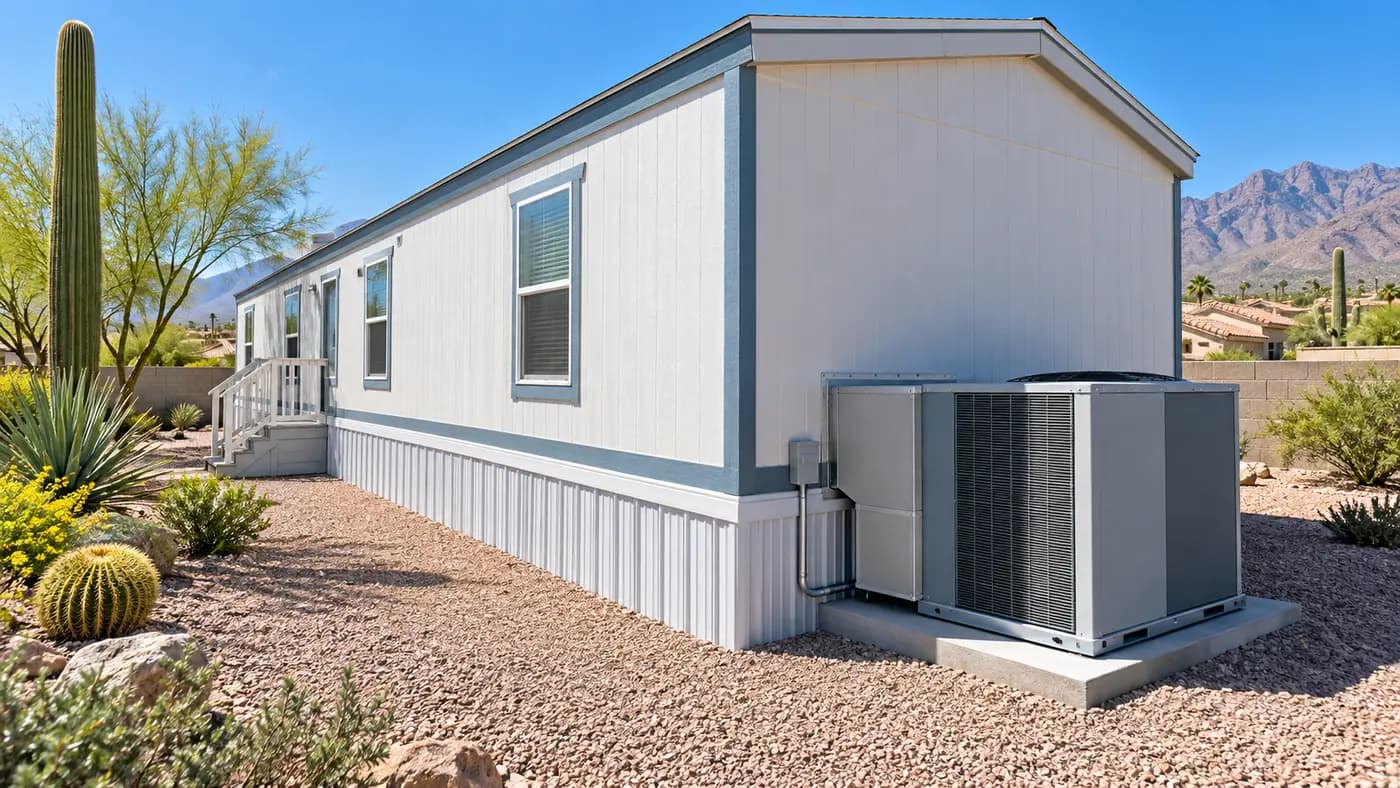
Many manufactured homes in the Valley are cooled by a package unit, either on the roof or on a pad beside the home, with a single duct connection into the floor plenum. Everything is in one cabinet outside, baking in the sun: compressor, coil, blower, and controls. Common failures are a weak capacitor that keeps the compressor from starting, a contactor pitted from years of cycling, a blower motor giving up, or a refrigerant leak at a joint stressed by the heat.It may simply be too small
Many manufactured homes shipped with equipment sized for a national average, not for a 112-degree afternoon under a low-slope roof with minimal attic space. If the unit is clean, charged, and ducted tight and it still cannot hold 78 by late afternoon, undersizing is on the table. That decision runs through the repair-versus-replace guide, and if replacement is the answer, our page on heat pumps for manufactured homes explains what fits.When to stop and call
Stop if the breaker trips twice, if you see ice, if you smell burning, or if the outdoor fan is not spinning while the compressor hums. Turn the system off at the thermostat. Bleuwave answers 24/7 with same-day service and quotes a flat rate before touching anything; estimates and financing on approved credit are explained on their own page. Manufactured home service covers the whole Valley, including Mesa, Glendale, and Peoria. A web page can narrow the list of causes. Only an on-site diagnosis, with a static pressure reading and a look under the home, can settle it.Why Isn't My Manufactured Home AC Cooling?: common questions
Straight answers, no runaround. Don’t see yours? Our team is a phone call away, around the clock.
The most likely cause is a crossover duct problem: the flexible duct connecting the two halves has sagged, disconnected, or been crushed, so the far side gets little or no air. It can only be confirmed from under the home. Our manufactured home duct repair page explains the fix.
We do not recommend crawling under a manufactured home. The space is tight, may contain damaged wiring, and the belly board can hide standing water or pests. A technician with proper lighting and a duct pressure test can confirm the problem without guesswork.
Air pulled from the crawlspace through gaps in the duct or belly board carries dust with it. That same gap lets your cooled air escape. Dusty registers are a strong sign of an under-floor duct leak rather than a problem with the equipment itself.
It might be, or the coil may be dirty, the blower weak, or the duct connection at the home leaking. Low refrigerant means there is a leak somewhere; topping it off without finding the leak is a short-term fix. A technician measures pressures and temperatures to sort out which it is.
Monthly during cooling season, and after every haboob. The air handler coil in a manufactured home is small and clogs faster than a full-size coil. A seasonal maintenance visit handles the coil cleaning a filter cannot prevent.
Possibly, especially if the home was built with minimal equipment and has since gained an enclosed porch, a west-facing addition, or aging insulation. Undersizing is a diagnosis of exclusion: the system has to be clean, charged, and ducted tight before anyone can say it is simply too small.
Often not. Package units live outside in full sun, and after two decades the cabinet, coil, and compressor have all aged together. Our repair-versus-replace guide lays out the factors, and a heat pump package unit sized for the home is usually the replacement path.
Yes, across the Valley, including the age-restricted communities in Mesa, Glendale, and Peoria. Same-day service is available, and the flat rate is quoted before any work begins. Park rules about equipment placement are something we work with routinely.
Manufactured Home AC Repair throughout the Phoenix area
Same-day appointments across Maricopa and Pinal counties. Pick your city for local pricing pages, reviews and service details.
Get under the home and find the real cause
An on-site diagnosis includes a duct pressure test and a look at the crossover and belly board, with a flat-rate quote before any repair.
- 24/7 emergency service
- Upfront, honest pricing
- Licensed, bonded & insured