What are the most common furnace repairs?
Most furnace trouble comes down to a short list: the flame sensor, the ignitor, the filter, the safety switches and the blower. Here is each one, what it does and what it typically costs.
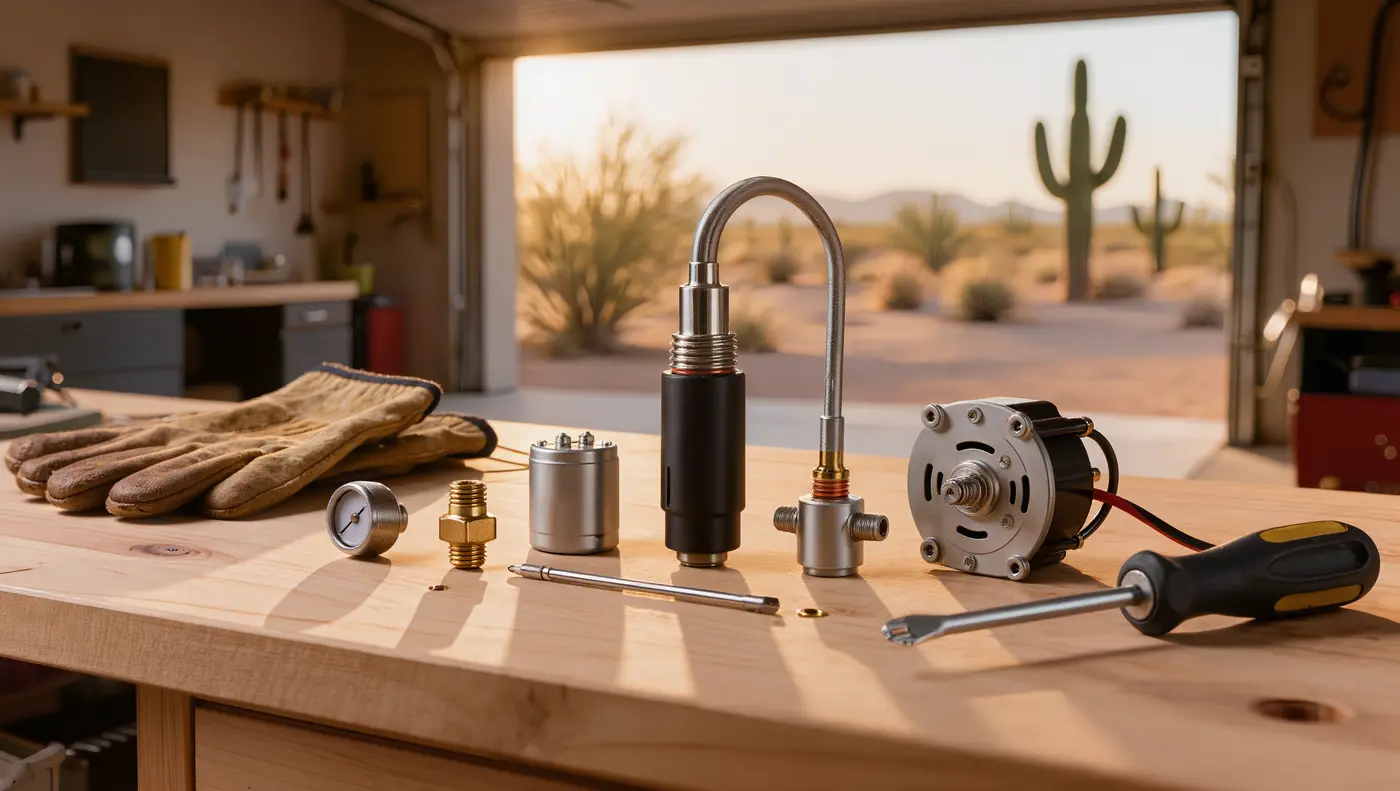
A furnace is not mysterious. It is a short chain of simple parts that each do one job: one proves the flame is lit, one lights it, one moves the air, a few make sure nothing overheats or backs up. When one link fails, the furnace stops, and usually it stops on purpose. Most furnace "failures" are safety controls doing exactly what they were built to do. Here are the parts that fail most often, in roughly the order a technician suspects them.
1. The flame sensor
A thin metal rod that sits in the burner flame. Its only job is to confirm there is a flame; if it cannot, the control shuts off the gas within seconds. A light film of grime is enough to make it doubt itself, which is why "it lights, then shuts off" is one of the most familiar furnace complaints there is. Cleaning often fixes it, and replacement is inexpensive. Trane's published range: $80 to $240.
2. The ignitor
Most modern furnaces light their burners with a hot surface ignitor, a small element that glows hot enough to ignite gas. Ignitors are brittle and wear with every start, and a cracked one simply stops glowing. The furnace goes through the motions, the inducer runs, and the burners never light. Trane: $100 to $250.
3. The filter, and everything it causes
The cheapest part in the furnace causes an outsized share of its problems. A clogged filter starves the furnace of air. The heat exchanger runs hot, a limit switch trips to protect it, the furnace cycles on and off, and the house never quite warms up. ENERGY STAR recommends inspecting filters monthly. In a Phoenix garage, where summer dust has had months to settle, that advice counts double. Our air filter guide covers what to buy.
4. Limit and pressure switches
These are the furnace's conscience. A limit switch shuts the burners down if the furnace overheats. A pressure switch confirms the inducer is venting exhaust before the burners are allowed to light. When they trip, they are usually telling the truth about something else: a clogged filter, a blocked vent, a failing inducer. Replacing a switch without finding out why it tripped is how a furnace gets fixed twice. Trane puts a limit switch at $100 to $375 and a pressure switch at $150 to $350.
5. The blower motor and its capacitor
The blower moves heated air through the ducts. In most split systems the same blower moves the cooled air all summer, so in Phoenix it rarely gets a season off. Motors wear, and the capacitor that helps them start often fails first. Trane: a capacitor runs $100 to $250, a blower motor $300 to $900.
6. The thermostat
Sometimes the furnace is fine and the thermostat is the problem: dead batteries, a loose wire, a setting someone changed in July. Trane's range is wide, $100 to $600, because thermostats run from basic to sophisticated. If you are replacing one anyway, consider a smart thermostat.
Less common, and more expensive
Further down the list sit the parts that cost real money: the draft inducer motor ($400 to $1,100), the gas valve ($200 to $800), the control board ($300 to $650) and, at the top, the heat exchanger ($1,000 to $3,000), all from Trane's guide. The last one gets its own article: the most expensive thing to fix on a furnace.
What this means for a Phoenix furnace
Short heating seasons and long idle summers favor the cheap failures: fouled sensors, tired ignitors, clogged filters. That is good news for your wallet and bad news for your timing, because they surface on the first cold nights, all over the Valley at once. A fall furnace tune-up cleans the sensor, checks the ignitor and replaces the filter before the season starts. If the furnace has already quit, see furnace repair, or read what it costs to fix a furnace.
Sources
Published figures are national ranges, not Bleuwave prices. Every Bleuwave repair is quoted flat-rate after diagnosis.
Need this handled, not just explained?
Same-day service across the Valley, upfront flat-rate pricing, and NATE-certified technicians available 24/7.