The filter question
How often, which one, and does the MERV number matter? The honest answer is that the wrong filter can hurt more than a dirty one.
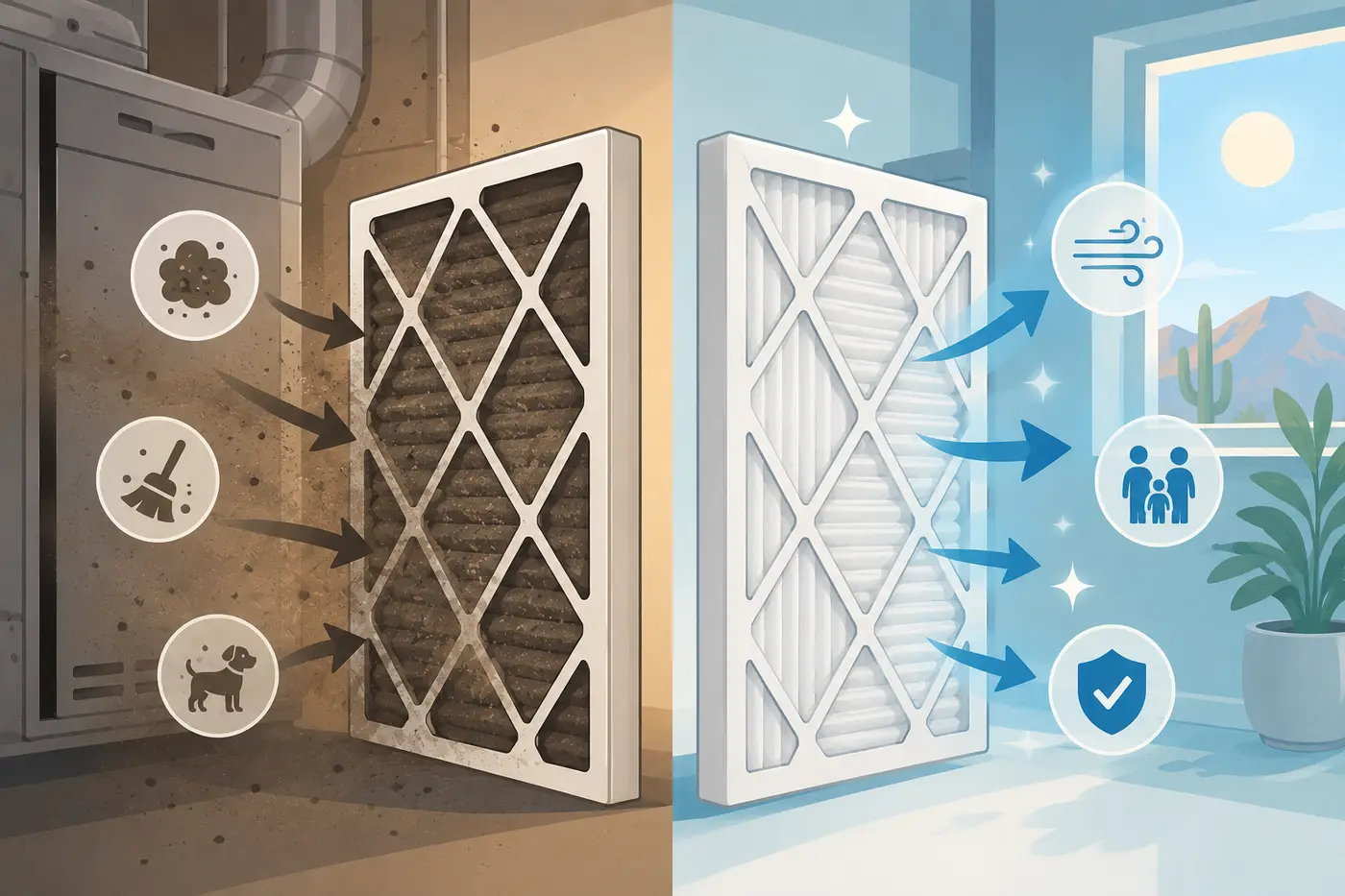
It is the cheapest maintenance item in the house and the one most consistently neglected, partly because nobody agrees on the answer. The box says ninety days. Your neighbor says thirty. The internet says it depends. Meanwhile the filter sits there quietly deciding how hard your air conditioner has to work.
How often, honestly
In a Phoenix home, plan on every one to three months, and lean toward the short end during summer and monsoon season when the system runs constantly and there is more dust in the air. Households with pets or anyone with allergies should check monthly. A one-inch filter clogs faster than a thick media filter, which may genuinely go six months or more.Rather than trust a schedule, look at it. Pull it out and hold it up to a light — if you cannot see light through it, it is overdue regardless of what the calendar says. That single habit prevents a meaningful share of the no-cool calls we take in July.
What a clogged filter actually does
It is not mainly about dirty air. Restricted airflow across the evaporator coil makes the coil too cold, which is the leading cause of a frozen coil. It also forces the blower to work harder, lengthens runtime, raises your bill, and in the longer term contributes to compressor stress. The filter protects the equipment at least as much as it cleans the air.Does MERV matter — and can it be too high?
Yes to both, and the second half surprises people. MERV rates how fine a particle the filter captures. Higher numbers catch more, including finer dust and allergens, which is genuinely valuable in a dusty climate.But a filter is also a restriction, and a very high-MERV filter in a system not designed for it reduces airflow. Less airflow means a colder coil, longer runtime, and the same problems a dirty filter causes — except now permanently, because you installed it deliberately. Residential systems generally do well in the MERV 8 to 13 range, with the upper end appropriate when the equipment and ductwork can support it.
The practical rule: a mid-range filter changed on time beats a premium filter left in too long, every time. If someone in the house has significant allergies and you want higher filtration, the right move is to ask whether your system can handle it rather than assuming — or to look at a thicker media filter, which offers more surface area and therefore more filtration without the same airflow penalty.
The things people get wrong
Installing it backwards — there is an airflow arrow, and it points toward the furnace or air handler. Buying the cheapest fiberglass panel, which protects the equipment but does little for air quality. Washing a disposable filter. And forgetting there is more than one return in the house, which is common in larger homes and means one filter is doing all the work while another is choked.If your registers are producing weak airflow even with a clean filter, the restriction is somewhere else — usually ductwork, sometimes a failing blower. We check filter condition, static pressure and airflow on every maintenance visit and will tell you which filter suits your specific system. Call (480) 863-5855.
Need this handled, not just explained?
Same-day service across the Valley, upfront flat-rate pricing, and NATE-certified technicians available 24/7.