Ice in July
There is frost on the copper line and the house is getting warmer. It sounds absurd in a Phoenix summer, and it is one of the most common calls we take.
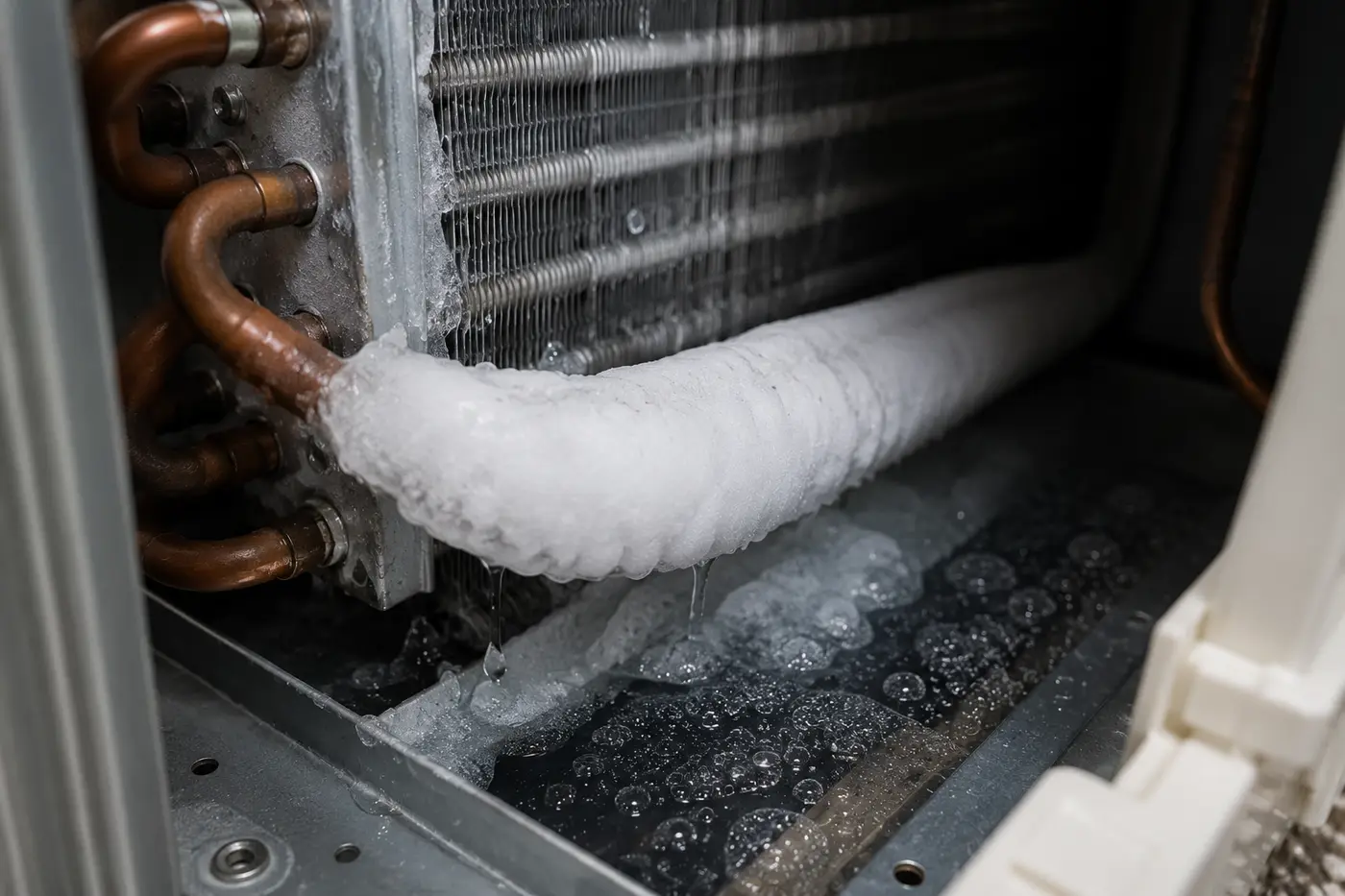
It is 112 degrees outside and there is ice inside your air conditioner. Homeowners find it two ways: a thick white sleeve of frost on the copper line running into the house, or water pooling on the floor near the indoor unit once that ice starts to melt. Either way the house is warming up, and the whole thing seems to defy physics.
It does not. An evaporator coil gets cold by design — that is how it pulls heat out of your air. It only turns to ice when something stops enough warm air from moving across it, so the coil keeps dropping below freezing and the moisture in your air condenses and freezes on contact. Everything that causes a frozen coil is a version of that same story.
Do this immediately
Turn the cooling off at the thermostat and switch the fan to ON. That stops the coil getting colder while the blower keeps moving room-temperature air across it, which thaws the ice far faster than shutting the whole system down. Expect it to take a few hours for a heavy freeze. Put towels down if there is a drain pan nearby.Do not chip at the ice with anything, and do not try to speed it up with a heat gun. Coil fins are thin aluminum and a punctured coil turns a modest repair into a refrigerant leak. And do not simply switch cooling back on once you see it running again — if you do not fix the cause, it will freeze right back up.
Then find out which cause it was
Restricted airflow. The most common by far, and usually the simplest: a clogged filter, closed or blocked supply registers, a dirty blower wheel, or crushed flex duct. Check the filter first; it solves a genuine share of these calls for the price of a filter.Low refrigerant. A system low on charge runs at lower pressure, which lowers the coil temperature and freezes it. As covered elsewhere, low charge means a leak — topping it off without finding the leak just buys you a few months.
A dirty evaporator coil. Dust builds an insulating blanket on the coil itself, so air passes over it without properly exchanging heat. The coil gets colder, the air stays warm, and ice forms.
A failing blower or a stuck control. Less common, but a blower motor running slow, or a system stuck running when it should have cycled off, produces the same result.
Why it matters beyond the inconvenience
A frozen coil is not just a comfort problem. Liquid refrigerant that should have evaporated can return to the compressor, and compressors are built to compress vapor, not liquid. Repeated freeze cycles are one of the more reliable ways to kill the most expensive component in the system. If yours has frozen more than once, treat it as a real fault rather than a quirk.Two of the four causes above are caught by a seasonal tune-up before they ever produce ice. If yours is frozen now, thaw it first, then call (480) 863-5855 — we run 24/7 emergency service and a technician can tell you in one visit which of these it was, with the price agreed before any work starts.
Need this handled, not just explained?
Same-day service across the Valley, upfront flat-rate pricing, and NATE-certified technicians available 24/7.