Is it normal for my AC to run all day in Arizona?
On a 114-degree afternoon, an air conditioner that never shuts off is usually doing its job. The trick is telling the difference between a system holding the line and one quietly losing it.
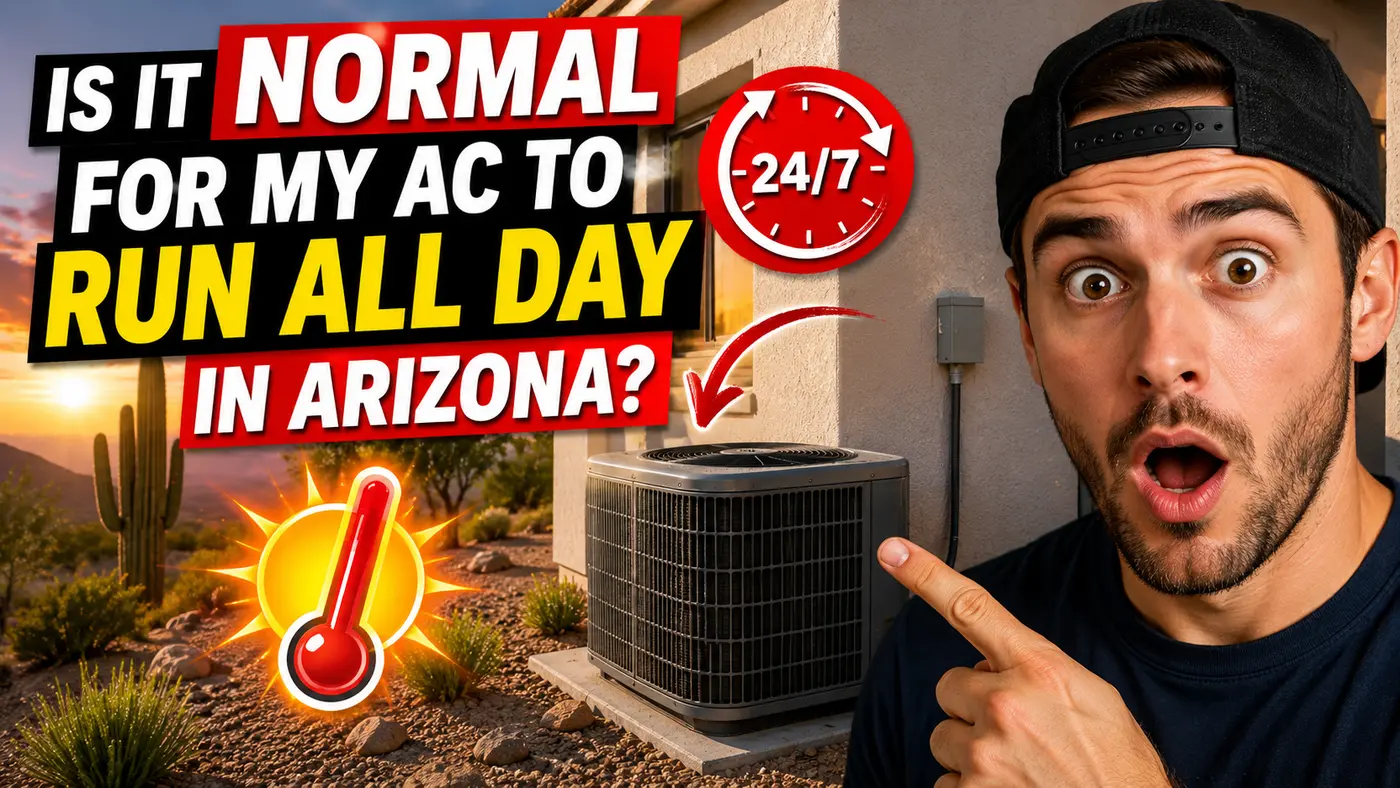
Sometime in the last week of June, the calls start. The homeowner is almost apologetic: the AC kicked on at ten in the morning, it is now dinner time, and it has barely stopped. Surely that means something is wrong. It is a fair question, and the answer surprises most people. On a 113-degree afternoon, an air conditioner that almost never shuts off is very likely doing exactly what it was built to do.
Your system was sized for this — barely, on purpose
Air conditioners are sized against a design temperature, and for the Phoenix metro that number is roughly 108 to 110 degrees. A correctly sized system is meant to just barely keep up on that day, running nearly flat out. You could oversize it to crush 115-degree afternoons with ease, but then you own a machine that short-runs, cools unevenly, and dehumidifies poorly the other 360 days of the year. So the trade is deliberate: on the handful of hottest days, near-continuous operation. That is the design working, not failing.The cruel math above 110
Two things happen at once as the afternoon climbs. The heat pushing into your house goes up, and your AC's ability to remove it goes down, because rejecting heat into 114-degree outdoor air is much harder than rejecting it into 95-degree air. The load rises while the output falls, and the only variable left is runtime. If your house is holding 78 or 79 while the porch thermometer reads 114, your system is winning a fight it was engineered to barely win. Let it run.The red flag is short, not long
The pattern that should actually worry you is the opposite one: the condenser firing up, quitting after a few minutes, and starting again, over and over. That is short-cycling, and nothing wears out a compressor faster than repeated starts. Long, steady runs are how compressors prefer to live. A marathon is fine. Wind sprints are not.When a long run actually is a problem
Three tells separate healthy runtime from struggle. First, the house cannot hold the setpoint — the thermostat reads 80 and climbing while the system never stops. Second, the air at the vents feels weak or barely cool. Third, the electric bill jumps sharply over the same month last year in similar weather; we covered what a spiking summer bill is really telling you separately. Any of those alongside constant runtime means something — a dirty coil, low refrigerant charge, leaking ducts, a tired compressor — is stealing capacity.What healthy looks like at the vent
You can check this yourself in fifteen minutes. With the system running a while, measure the air temperature at a return grille, then at the nearest supply vent. You want an 18 to 20 degree drop between them. Nail that split with long, even cycles, and all-day running in extreme heat is nothing but physics doing its job. A split of 10 or 12 degrees means the machine is running long to compensate for capacity it has lost, and that is worth a diagnosis before the next heat wave finds the weakness for you.August is decided in April
The difference between a system that cruises through twelve-hour days and one that buckles is usually maintenance, not luck. A clean condenser coil, correct charge, a fresh filter, and free-flowing ducts are what an annual tune-up verifies, and our maintenance memberships from $149 a year keep it on the calendar so you never have to think about it until the thermostat gives you a reason.So no — an AC that runs all day during an Arizona heat wave is not broken. It is holding the line. But if it runs all day and loses ground, blows tepid air, or sends your bill through the roof, call (480) 863-5855 and we will find out where the capacity went. Or grab the $129 tune-up now and make your system one of the boring ones.
Need this handled, not just explained?
Same-day service across the Valley, upfront flat-rate pricing, and NATE-certified technicians available 24/7.