Why is upstairs always hotter?
Downstairs is fine, the bedrooms are baking, and the thermostat swears everything is under control. The two-story problem is built into the house — here is the ladder of fixes, from free to permanent.
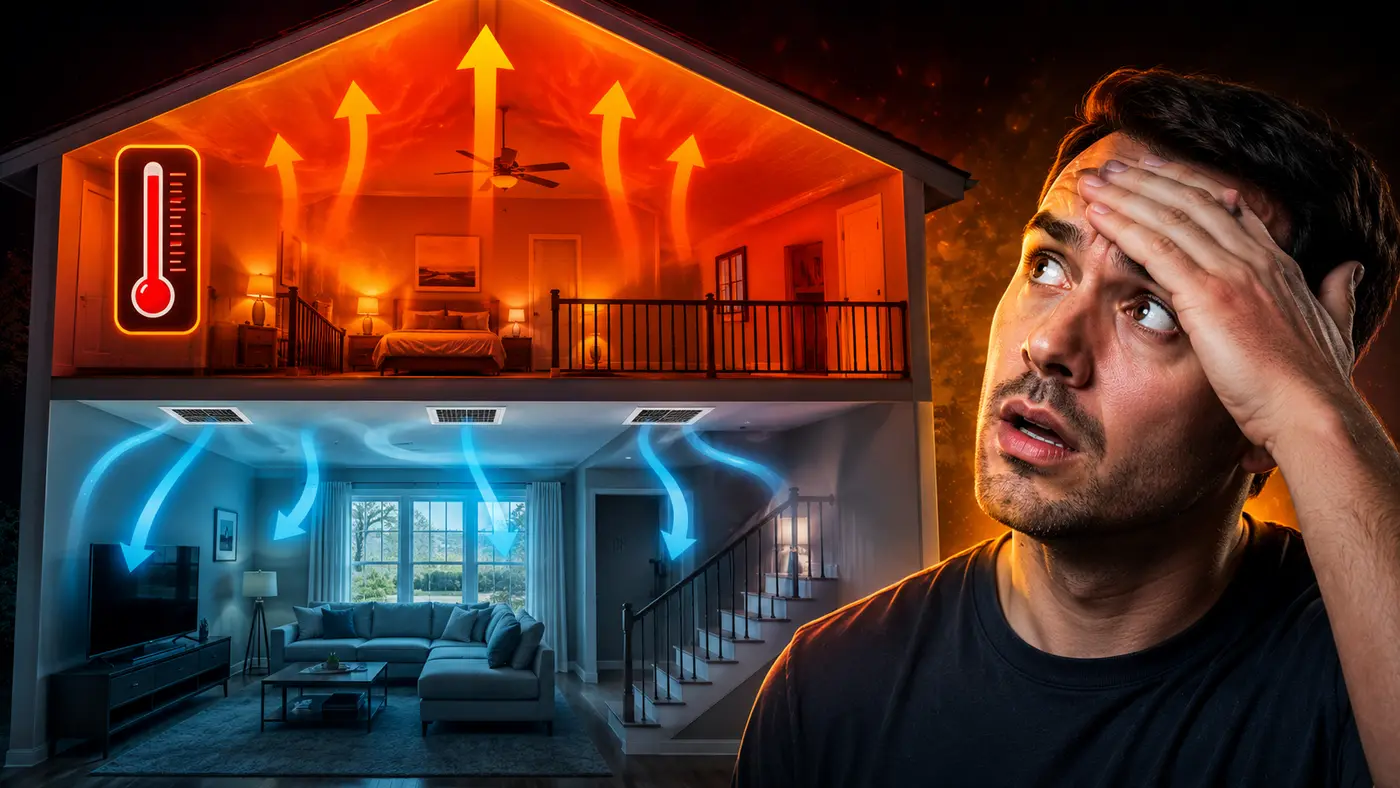
Walk up the stairs of any Valley two-story in July and you can feel the line. Somewhere around the fourth step the air changes, and by the landing you have left the house your thermostat lives in and entered a different climate. Downstairs holds 77. Upstairs reads 84, and the bedrooms are worse. If it were one stubborn room, you'd be reading a different article. This is the whole floor, and it happens for reasons that were built into the house before you ever moved in.
You live under an oven
Heat rises — everyone knows that part. What people underestimate is what sits above the second floor: an attic that hits 150 to 160 degrees on a summer afternoon and stays hot well past midnight. Every upstairs ceiling is the floor of that oven. If the attic insulation is thin, settled, or was minimal to begin with, heat pours down into the bedrooms all evening — which is exactly when you want them cool. Downstairs never has this problem, because downstairs has an entire air-conditioned floor over its head instead.
One thermostat, and it lives downstairs
Most two-story homes here run a single system with a single thermostat mounted in the coolest, shadiest hallway on the first floor. When that hallway hits 77, the system decides its work is done and shuts off — while the master bedroom sits at 84. Nothing is broken. The equipment is obeying a sensor that has no idea the second floor exists. That is a design problem, not a repair problem, and no new equipment fixes it as long as one sensor speaks for two climates.
The air upstairs has nowhere to go
Here is the one almost nobody checks: return air. Builders were generous with supply registers and stingy with returns, and plenty of Valley two-stories have exactly one return for the whole upstairs — or none at all, just the gap under each bedroom door. Cold air cannot flow into a room if the hot air already in it cannot get out. The result is bedrooms that receive a trickle of supply while the warm air near the ceiling just sits there. Adding or enlarging returns is unglamorous work that beats most equipment upgrades dollar for dollar.
Your cold air commutes through the attic
The ducts feeding the second floor usually run through that same 150-degree attic. Between leaks at every joint and plain heat gain through the duct walls, air that left the system at 55 degrees can arrive at the far bedroom in the mid-60s. Sealing the ductwork gets that air there still cold, and in a two-story it often matters more than anything you could do to the equipment itself.
The fix ladder, cheapest rung first
Before you spend real money: switch the thermostat fan from AUTO to ON so the blower keeps mixing the two floors between cooling cycles — it costs a few dollars a month in electricity and shaves a degree or two off the gap in a lot of homes. Put in a fresh filter. Close blinds on east and west glass before the sun arrives, not after. Run the bedroom ceiling fans. None of this fixes the underlying design, but together it can turn unbearable into livable while you plan the real fix.
The middle rungs cost real money but a fraction of new equipment: seal the ducts, top the attic insulation up to current code, and give each bedroom a working return path. Each one attacks a specific loss — heat coming in, cold going missing, air with nowhere to circulate. Combined, they routinely close most of the gap, and they cut the electric bill too, because right now you are paying to cool air that never reaches the rooms you sleep in.
The real fix: give upstairs its own vote
If the gap survives all that, the answer is separate control. Zoning divides your existing system with motorized dampers and hands the second floor its own thermostat. Or skip the ductwork entirely and put a dedicated ductless mini-split on the upstairs — the bedrooms get their own quiet, efficient cooling, and the main system stops fighting a battle it was never designed for. What we will not tell you to do is buy a bigger air conditioner. Oversizing does not fix a hot second floor; it just makes an expensive system short-cycle.
If your upstairs runs hot, tell us how bad it is and how old the house is, and we will tell you which rung of the ladder to start on — including the rungs that do not involve paying us anything. Call (480) 863-5855 or request a free estimate on zoning, duct sealing, or a mini-split for the second floor.
Need this handled, not just explained?
Same-day service across the Valley, upfront flat-rate pricing, and NATE-certified technicians available 24/7.