How long an air conditioner really lasts here
The brochure says fifteen to twenty years. The brochure was not written for a climate that runs the system four months straight at 110 degrees.
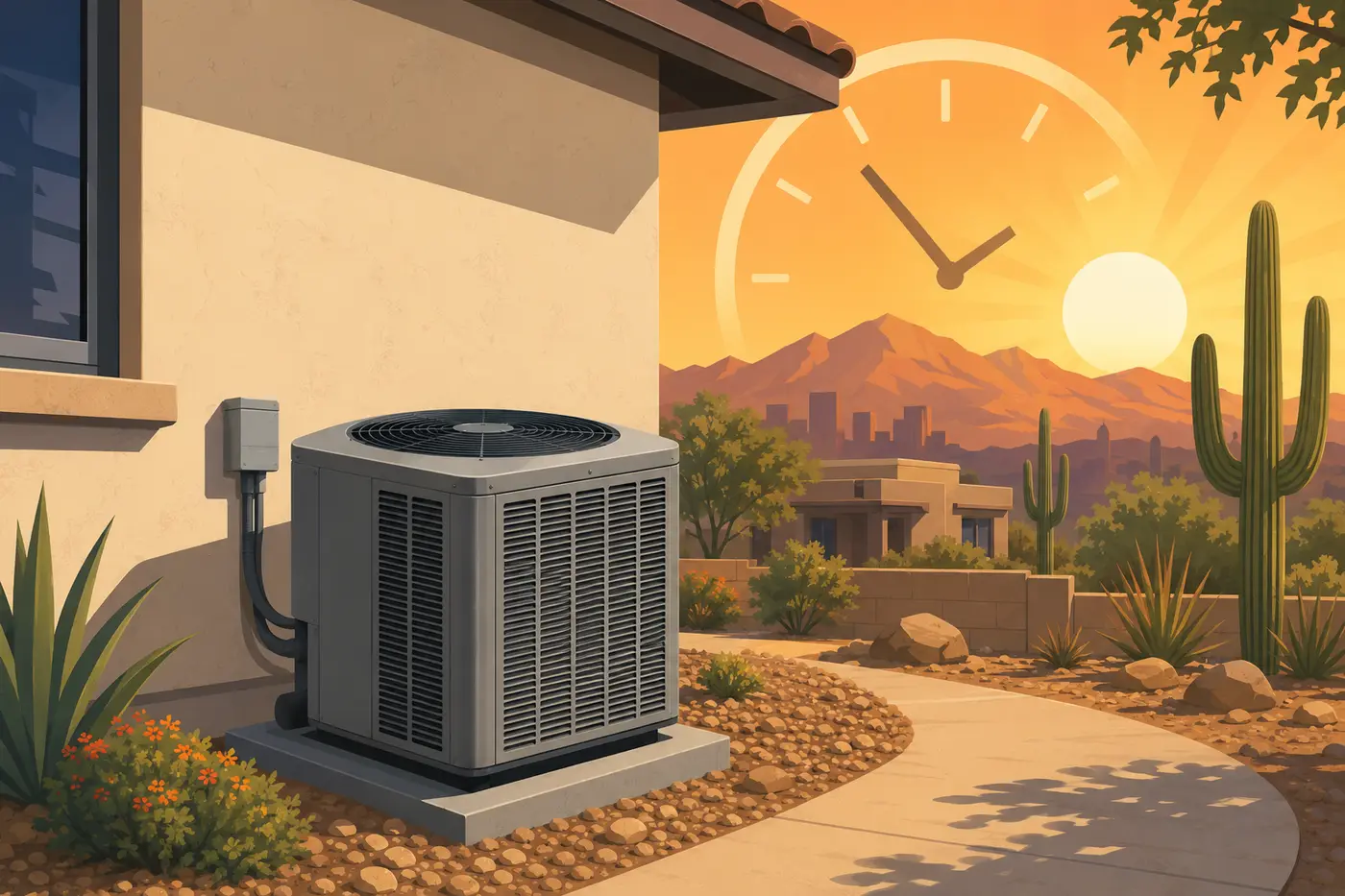
Ask a manufacturer how long an air conditioner lasts and you will hear fifteen to twenty years. Ask a technician who works in Phoenix and you will hear something shorter, and the gap between those two answers is worth understanding — because it is the difference between planning for a replacement and being ambushed by one.
In the Valley, ten to fifteen years is the realistic working life of a residential system, with well-maintained equipment landing at the top of that band and neglected equipment falling below it. That is not because the equipment is worse here. It is because of duty cycle.
Why the desert is harder on equipment
A system in a temperate climate runs intermittently for a few months a year. A system here runs nearly continuously from May through September, often through nights that never drop below 90. Every component — compressor, fan motors, capacitors, contactors — accumulates run hours several times faster than the same unit installed somewhere mild.Then add heat itself. Capacitors in particular are rated for temperature ranges that a Phoenix rooftop cheerfully exceeds, and every extreme afternoon shortens their life. Add dust and caliche grit that pack condenser coils, and monsoon debris, and you have a set of conditions that ages equipment on an accelerated schedule.
So a twelve-year-old system here is not middle-aged. It is elderly, and it should be treated as a known future expense rather than a surprise.
What actually extends it
The single biggest variable is maintenance, and the effect is not marginal. A coil cleaned annually, a charge kept at specification, capacitors tested and replaced before they fail, and a drain line kept clear — that combination routinely buys years, because most catastrophic failures are downstream of something small that went unattended.The compressor is the component that decides the system's fate, and compressors mostly die from conditions rather than age: running against a filthy coil, running low on refrigerant, or repeated liquid return from a coil that keeps freezing. Prevent those and you are protecting the expensive part. Our $129 tune-up exists for exactly this reason, and it is the least glamorous money you will spend on the system.
Signs you are entering the last stretch
None of these individually means replace. Together they mean start planning: repairs arriving more than once a summer, a bill that climbs every year despite maintenance, rooms that never quite reach temperature anymore, a system past twelve, or a major component quote — compressor, evaporator coil — on aging equipment.Why planning beats reacting
Here is the practical argument. A system that dies in July dies at the worst possible moment: you are hot, you are rushed, availability is thin across the whole Valley, and you will accept the first workable option. A homeowner who knows they are two summers out gets to compare quotes calmly, take advantage of shoulder-season scheduling, and use 0% financing deliberately rather than in a panic.If you want to know honestly where yours sits, ask us on the next visit — we will tell you the age, condition, and what we would do in your position, including when that answer is "nothing yet." You can also price a future replacement in about thirty seconds with our instant estimate. Call (480) 863-5855.
Need this handled, not just explained?
Same-day service across the Valley, upfront flat-rate pricing, and NATE-certified technicians available 24/7.