
Aeroseal Duct Sealing, Explained for Phoenix Homeowners
Aeroseal is a process, not a piece of equipment. This page explains how aerosolized duct sealing works, where it fits, and what Bleuwave does about leaky ducts instead. It is informational; Bleuwave does not perform the Aeroseal process.
- Informational page, not a service offer
- Bleuwave does not perform Aeroseal
- We test and hand-seal ducts instead
- Leak rate measured before any advice
Schedule today — we’re here 24/7.
Independent service. Bleuwave HVAC is not affiliated with, endorsed by, or an authorized dealer of Aeroseal. Aeroseal and related product names are trademarks of their owners. We service and replace this equipment as an independent contractor.
About Aeroseal
Aeroseal is the name of both a company and a duct-sealing process that is licensed to contractors who buy the equipment and training to run it. Corporate ownership is listed as independent in our seed catalog, with detail research pending. The process arrived in residential HVAC with a specific promise: seal the leaks you cannot reach, from the inside, without tearing into ceilings. Bleuwave HVAC is an independent service company. We are not affiliated with, endorsed by or an authorized provider of Aeroseal, and the trademark belongs to its owner. Bleuwave does not perform the Aeroseal process. We publish this page because Phoenix homeowners search for it, and because the underlying problem it addresses, duct leakage, is the single most common thing we find wrong in Valley attics.The product family: one process
The seed catalog lists a single family, the Aeroseal duct-sealing system, and describes it as an aerosolized duct-sealing process. Here is what that means mechanically. The technician blocks the registers and the equipment, pressurizes the duct system with a fan, and injects a mist of sealant particles into the airstream. Air escaping through a gap carries particles to the edge of that gap, where they collect and build up until the opening closes. A gauge tracks leakage falling in real time, and the job ends when the number stops moving. The process is designed for the small, scattered leaks at joints and seams that are physically impossible to reach in a flat Phoenix attic packed with blown insulation. It is not designed for a disconnected trunk, a crushed flex run or a return that was never connected to anything, and those are common in tract homes built during the boom years. Equipment details and sealant specifications are research pending.Common duct problems the process is asked to solve
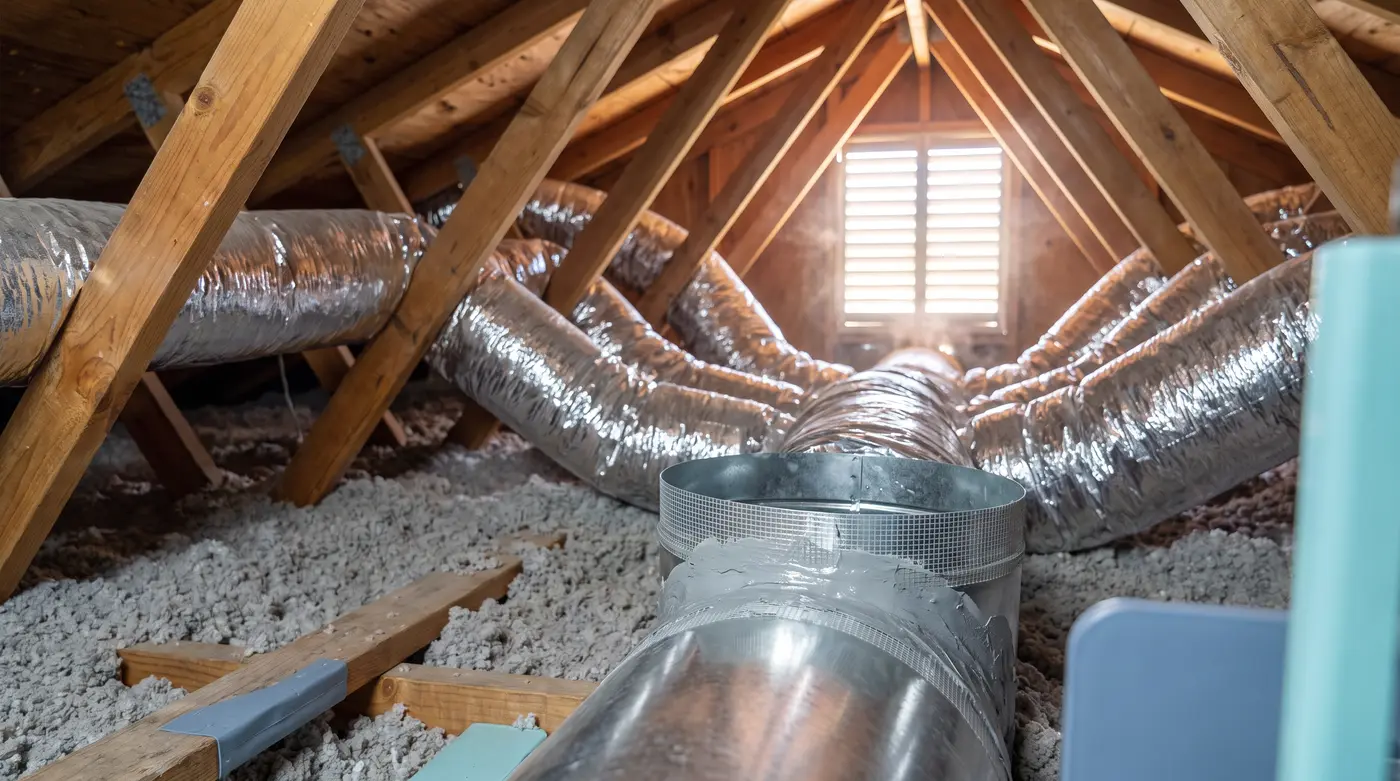
Every leak in a Valley attic costs twice. Supply leaks push conditioned air into a 155-degree attic. Return leaks pull that attic air, and its dust, into the system upstream of the coil. The symptoms are familiar.- One room never cools. Usually a supply run losing pressure before it reaches the far bedroom. Our field note on the room that never cools walks through it.
- Dust on the filter days after changing it. A return-side leak in the attic, drawing haboob residue past everything meant to stop it.
- Long runtimes and high bills. The system makes cold air; the attic gets a share of it.
- Musty air after monsoon. Humid attic air pulled through a return leak onto a cold coil.
Sealing vs replacing the ductwork
The repair-versus-replace question applies to ducts as much as to equipment. Flex duct in a Phoenix attic has a finite life; the outer jacket cracks, the inner liner tears, and the insulation slumps. Sealing thirty-year-old flex, by any method, buys time on a material that is failing everywhere at once. When the ducts are structurally sound and the leaks are at the joints, sealing wins on cost and disruption. When the runs are undersized, kinked or crumbling, a redesign and replacement is the honest recommendation, and the repair-versus-replace guide lays out how we weigh it. The decision needs a leakage number, a static-pressure reading and eyes on the attic. None of those come from a web page.What Bleuwave does instead
We do not run the Aeroseal process and will not pretend otherwise. What we do is the manual version, with instruments.- Test first. A duct-leakage and airflow test measures how much air the system loses and where the pressure drops.
- Seal by hand. Mastic and proper collars on every accessible joint, boot and plenum seam, which in a Phoenix attic means a technician working before the attic hits 130 degrees. The duct sealing page describes the scope.
- Fix what sealing cannot. Reconnect fallen runs, replace crushed flex, resize returns and add insulation where the jacket has failed.
- Retest. The after number is the proof, and you get it in writing.
Service, warranty and honest notes
Any warranty on an aerosol sealing job is between the homeowner and the contractor who performed it, and terms are research pending. We make no claims about the durability of the sealant in Arizona attic temperatures because we have not tested it; ask the provider for their data. What we can offer is a flat-rate quote for testing and manual sealing, delivered before any work begins, with financing on approved credit when the scope grows into duct replacement. Duct sealing is also the one job that tends to make a system look better on a maintenance visit, because a system that is no longer pulling attic dust stays cleaner longer. The next step, whichever method you end up choosing, is the same: an on-site evaluation that puts a number on the leak. Without that number, nobody, including us, can tell you whether sealing is worth doing.Aeroseal at a glance
- Current label
- Aeroseal
- Former labels
- research pending
- Parent relationship
- independent / research pending
- Verified series / prefixes
- Aeroseal duct-sealing system
- Equipment types
- Duct leakage treatment process (aerosolized sealant injected into a pressurized duct system)
- Configurations
- Process rather than installed equipment; research pending
- Refrigerant or energy source
- research pending
- Era and status
- current
- Phoenix application
- Attic flex-duct systems in tract homes; not applicable to disconnected runs or undersized returns
- Common search intent
- cost, duct sealing, leaky ducts, one room hot, estimate, alternatives
Product families in the record
- Duct leakage treatmentAeroseal duct-sealing systemAerosolized duct-sealing process licensed to equipped contractors. Informational only: Bleuwave does not perform the Aeroseal process and instead tests and hand-seals ducts.
Aeroseal Duct Sealing, Explained for Phoenix Homeowners: common questions
Straight answers, no runaround. Don’t see yours? Our team is a phone call away, around the clock.
No. This page is informational. We are not affiliated with or authorized by Aeroseal, and we do not run the aerosol process. We test duct leakage with instruments and seal by hand with mastic and proper connections, then retest to prove the result.
It reaches leaks a hand cannot, which matters in a flat attic buried in insulation. It does not fix disconnected runs, crushed flex or undersized returns. Which approach suits a given house depends on the leak test and a look at the ducts, not on a preference.
Signs include a room that never cools, a filter that loads within days, long runtimes and a dusty smell after monsoon storms. The only real answer is a leakage test. Our airflow testing page explains what the numbers mean.
If the ducts leak meaningfully, sealing reduces the conditioned air lost to the attic, which reduces runtime. We do not promise a figure; the savings depend on the leak rate, the attic temperature and your rate plan. The summer electric bill field note covers where the money usually goes.
Yes. A sealed duct system is a sealed duct system, and we service the equipment and ducts around it like any other. If leakage has crept back, we retest and hand-seal whatever has opened.
If the jacket is cracked and the liner is tearing, sealing buys a little time on a material that is failing everywhere at once. Sound ducts with leaky joints are worth sealing. We put both options in writing after seeing the attic, following the repair-versus-replace framework.
Sealing ducts tightens the distribution, not the house, so it does not starve the system of air. It can reveal an undersized return that leakage was quietly masking. That is why we measure static pressure before and after and address the return if needed.
Aeroseal service throughout the Phoenix area
Same-day appointments across Maricopa and Pinal counties. Pick your city for local pricing pages, reviews and service details.
Put a number on the leak before deciding anything
Schedule an on-site duct evaluation. We measure leakage and static pressure, look at the attic, and tell you whether sealing, repair or replacement is the honest answer.
- 24/7 emergency service
- Upfront, honest pricing
- Licensed, bonded & insured