Why Phoenix air conditioners always fail in July
It is never random. After nine years of summers in the Valley, the same four failures account for most of the calls — and three of them are preventable.
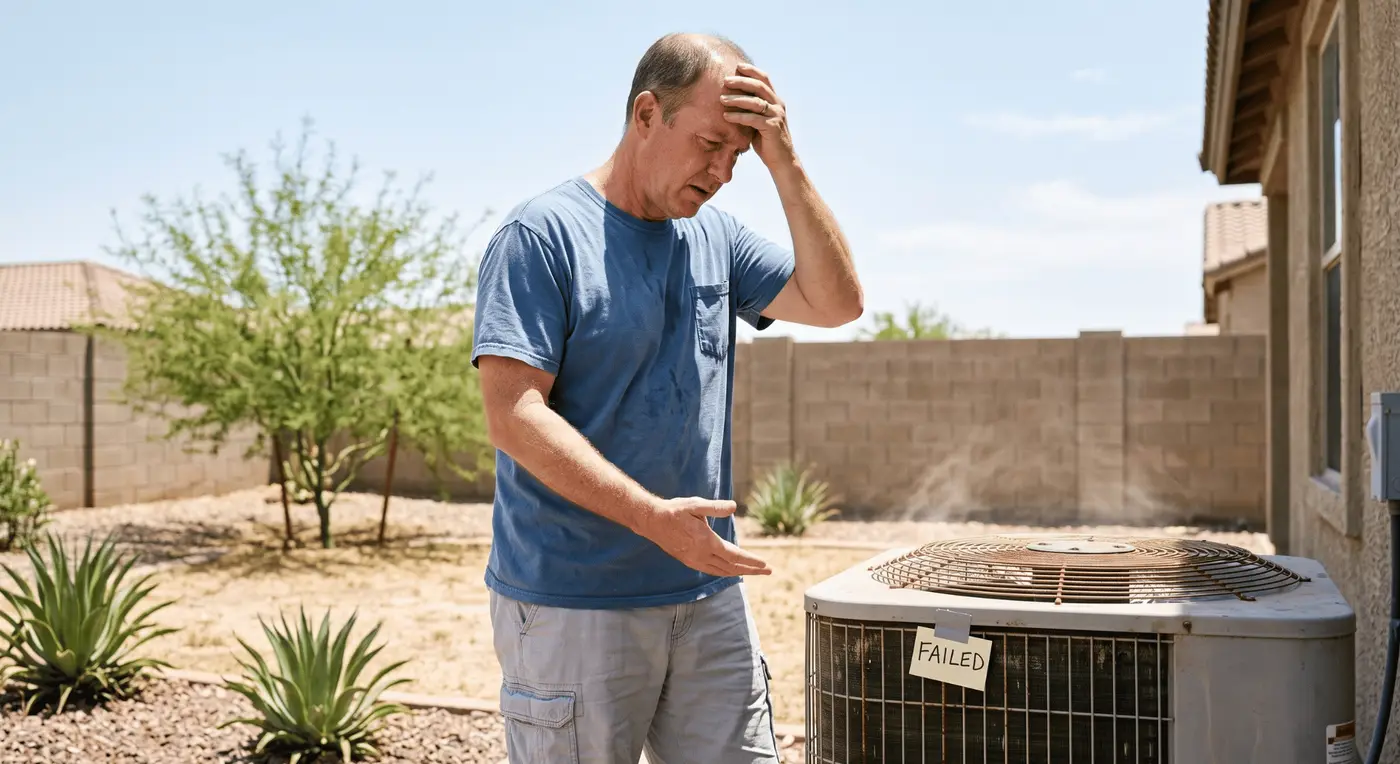
Ask any technician in Phoenix when the phone rings hardest and they will tell you the same thing: the second week of July, right after the first stretch of 112-degree days. Not June, when the heat arrives. July, when the heat has been leaning on the equipment for three weeks straight and something finally gives.
That timing is not coincidence, and the failures are not random. When you strip away the details, most Valley breakdowns come down to four culprits — and three of them announce themselves months in advance to anyone who bothers to look.
1. The capacitor
The capacitor is a small cylinder that gives your compressor and fan motor the jolt they need to start. It is also the single most common failure we replace. Heat is what kills it: a capacitor rated for a temperate climate lives a hard life on an Arizona rooftop, and every 115-degree afternoon shortens it. The tell is a system that hums but will not start, or one that runs fine at nine in the morning and quits at four in the afternoon. A capacitor is a cheap part. Replaced during a spring tune-up, it is a footnote. Replaced at 11 p.m. in July, it is an emergency call.2. The dirty condenser coil
Your outdoor unit works by dumping your home's heat into the outside air. When the coil is packed with dust, cottonwood, and the fine caliche grit that blows across the Valley, it cannot dump that heat. The system responds by running longer and hotter, pressures climb, and eventually the compressor — the most expensive component you own — pays the price. We have pulled coils so choked you could not see daylight through them. The homeowner's only symptom was a power bill that had quietly climbed forty dollars a month.3. Low refrigerant, which really means a leak
Refrigerant is not fuel. It does not get used up. If your system is low, it is because it is leaking, and anyone who simply tops you off and drives away has sold you a repair with an expiration date. We find the leak. Sometimes it is a corroded evaporator coil, sometimes a fitting that vibrated loose over a decade. Either way, the honest fix is to repair the leak and recharge to spec — or, if the coil is finished on a fifteen-year-old system, to have the harder conversation about replacement.4. The drain line
This is the humble one. Your air conditioner pulls moisture out of the air, and that water has to go somewhere. When the drain line clogs with algae, the safety switch trips and shuts the whole system down — or worse, the pan overflows into your ceiling. It is a fifteen-minute clear during maintenance and a miserable discovery on a Sunday.What this means for you
Three of those four failures are caught by a competent annual inspection. That is the entire argument for maintenance, and it is not a sales pitch — it is arithmetic. A capacitor tested and replaced in April costs a fraction of the same part installed at midnight in July, and it does not come with a sleepless night attached.If your system has not been looked at since last summer, get ahead of it. Our $129 tune-up includes a condenser coil cleaning, a capacitor test, a refrigerant check, and a drain clear — the exact four items above. And if your AC has already quit, call (480) 863-5855. We answer at any hour, and we will tell you the truth about what we find.
Need this handled, not just explained?
Same-day service across the Valley, upfront flat-rate pricing, and NATE-certified technicians available 24/7.