Why does my AC smell?
Your nose finds AC problems before any gauge does. Some odors can wait a week, one deserves a call today, and two mean walking to the breaker panel before you pick up the phone.
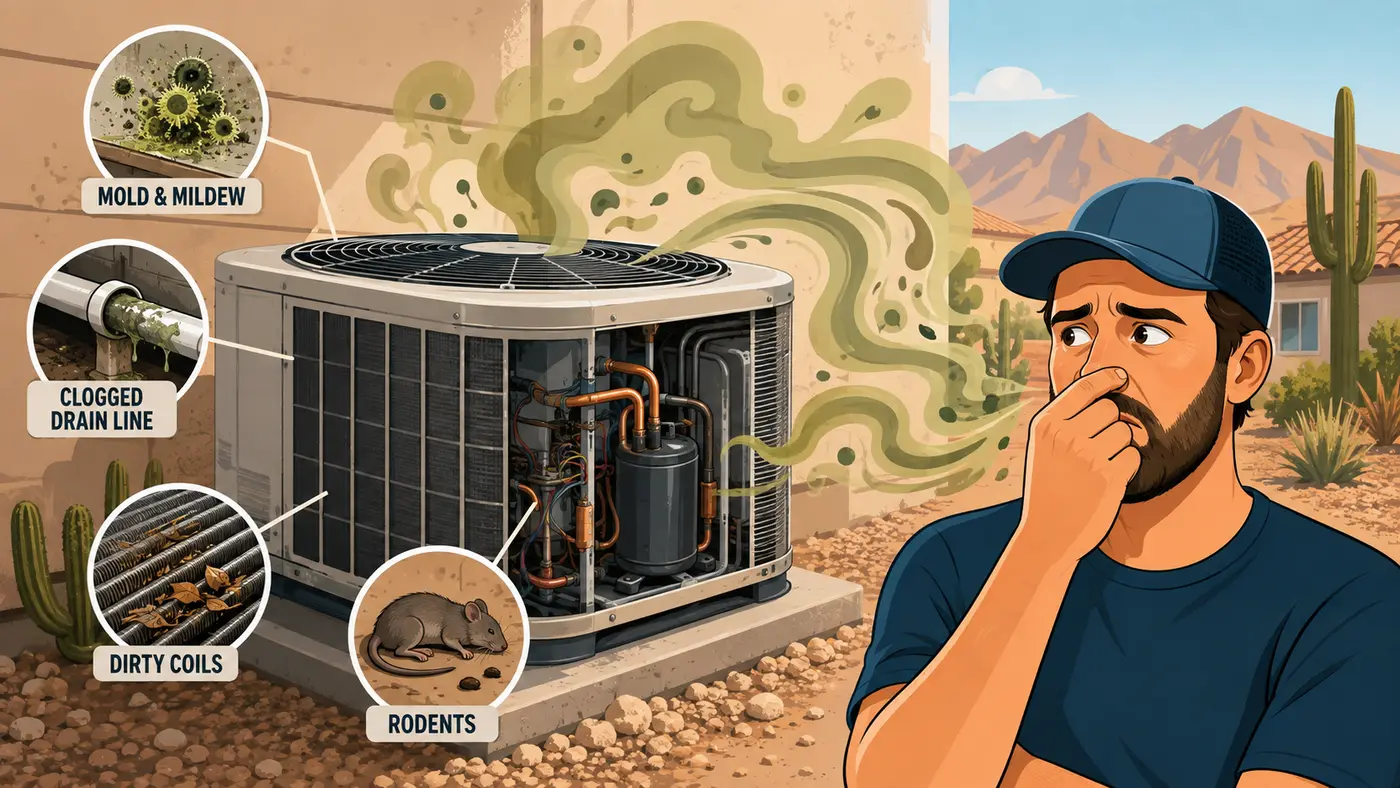
Every experienced tech does the same thing walking into a house on a comfort call: we sniff. Smell is one of the fastest diagnostics in this trade, because different failures produce different odors, and odors rarely lie. Some are harmless. Some are worth a visit this week. And one or two mean you should shut the system off before you call anyone. Here is the field guide, odor by odor.
Musty, like gym socks or a wet towel
The most common one in the Valley, and it peaks during monsoon season for a reason. Your evaporator coil is cold, wet, and sitting in the dark, and once monsoon humidity pushes indoor moisture up, that coil becomes a greenhouse for biofilm — a thin bacterial slime coating the fins and the drain pan. Every time the blower starts, you get the locker-room hit through the vents. It will not fix itself, and a clogged drain line often follows the smell by a few weeks. A proper coil cleaning and drain treatment handles it, and if it keeps coming back, a UV light or better filtration from our indoor air quality lineup keeps the coil clean for good. Verdict: call this week, not this minute.Burning, hot plastic, or anything electrical
Take this one at face value. A burning smell from the vents or the indoor unit usually means a motor overheating, wire insulation cooking, or a capacitor on its way out, and all three get worse with every minute of runtime. Do not wait to see if it clears. Turn the system off at the thermostat, then at the breaker, and call for AC repair. Caught early, this is often a modest part swap. Let it run, and a failing blower motor can take a control board with it. Verdict: shut it off now.Chemical, sweet, or faintly like nail polish remover
Refrigerant has a smell — mildly sweet, vaguely chemical, something like ether. If you notice it near the indoor unit or at a supply vent, you may have a refrigerant leak, often at the coil. The system will still cool for a while, which is exactly why people ignore it, and then one August afternoon it does not. The refrigerant is also going somewhere, and breathing it is nothing to be casual about. Verdict: call today.Rotten eggs when the heat kicks on
This is not really an AC smell at all, and that is the point. Natural gas is odorless, so utilities add mercaptan — the rotten-egg scent — precisely so you notice. If you smell it when a gas furnace fires on a cool morning, do not troubleshoot. Get people and pets outside and call the gas company from the driveway, then call us. Gas heat is a different problem from everything else on this list, and it is the one we want you to over-react to. Verdict: take it seriously, every single time.Dusty burning on the first cold night of fall
This one is free. All summer, dust settles on the furnace's heat exchanger and heat strips. The first night the desert finally drops cold enough for heat, that dust burns off, and the house smells faintly scorched for twenty or thirty minutes. Crack a window. If it fades within the hour, it is normal. If it lingers into the next day or turns to hot plastic, apply the burning-smell rule above. Verdict: live with it, once a year.When every room smells, look at the ducts
If an odor is everywhere at once instead of strongest near the unit, the distribution system is usually the messenger. Leaky return ducts in a Phoenix attic pull in hot, dusty attic air — and whatever that air carries — and push it through your vents. Older flex duct also holds years of accumulated dust that adds a stale note to everything. Duct cleaning and sealing fixes the smell and trims the cooling bill at the same time, since conditioned air stops escaping into the attic.So the shorthand. Dusty burn-off in fall: live with it. Musty gym socks: book a visit this week. Chemical or sweet: call today. Burning or electrical: breaker first, phone second. Rotten eggs: out of the house. Your nose caught the problem earlier than any gauge could. Do not let the follow-up lag behind it.
If your AC smells like anything other than nothing, call (480) 863-5855 and we will tell you over the phone whether it can wait — honestly, even if the answer costs us a service call. Or take $50 off the repair by booking online. And if it is the burning one, make the breaker your first stop and us your second.
Need this handled, not just explained?
Same-day service across the Valley, upfront flat-rate pricing, and NATE-certified technicians available 24/7.