What SEER2 rating do you actually need in Phoenix?
Efficiency ratings are miles-per-gallon for cooling, and nowhere in America does the math matter more than here. But the salesman's favorite number has a point of diminishing returns — and we'll show you where it is.
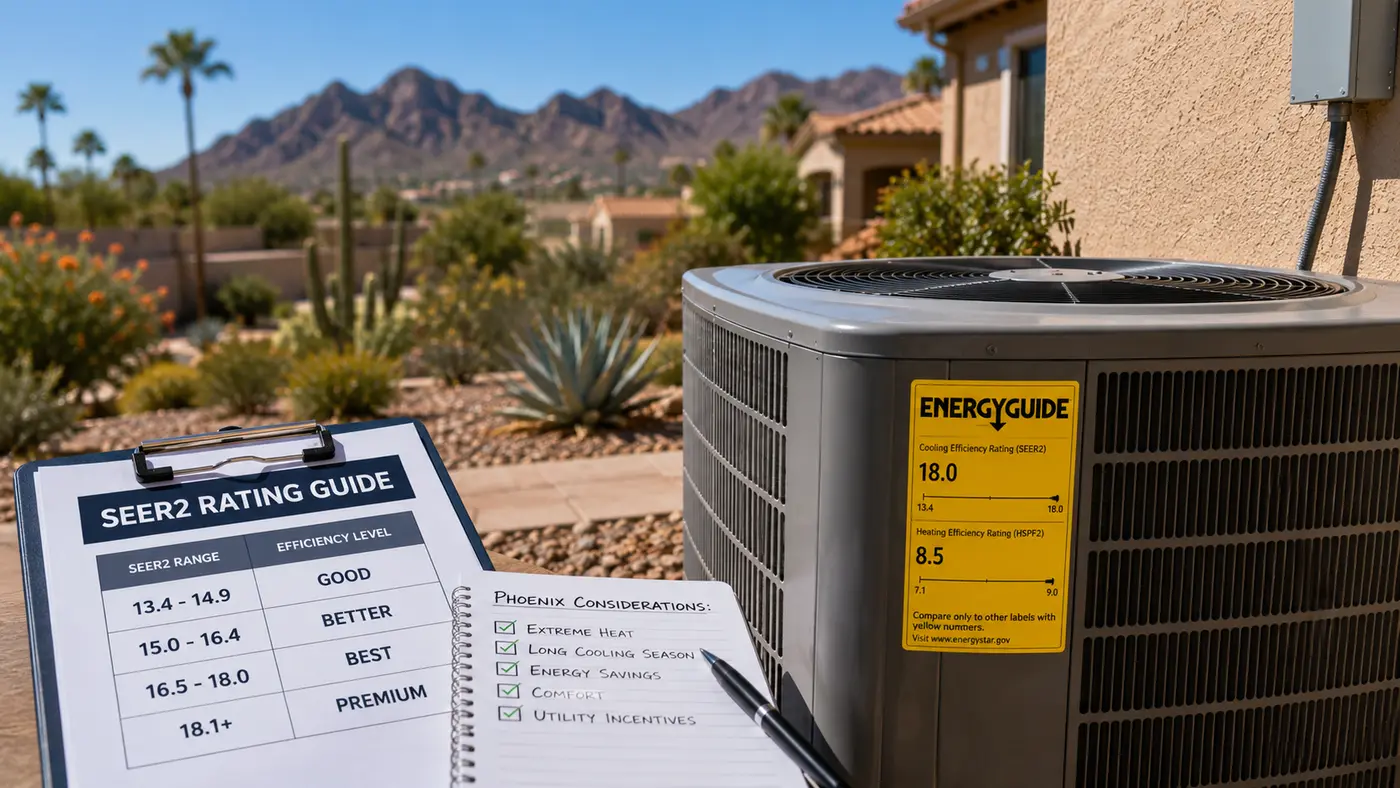
Shop for a new air conditioner and you'll be buried in SEER2 numbers before anyone asks about your house. Here's the plain-English version: SEER2 is miles-per-gallon for cooling. It measures how much cooling a system delivers for every unit of electricity it burns over a season. Higher number, lower power bill. That's the whole concept.
Why the 2?
SEER2 replaced the old SEER rating in 2023, and the change was more than cosmetic. The old test ran units against almost no duct resistance — lab conditions no real attic has ever seen. The new test adds realistic static pressure, the way air actually moves through ductwork in your house. Same unit, tougher test, so the numbers dropped: a 14.3 SEER2 is roughly the old 15 SEER. If you're comparing a quote against a system you bought years ago, don't panic when the new number looks lower.The floor is already set for you
The Department of Energy splits the country into regions, and Arizona sits in the Southwest region with the strictest rules in the nation. A new central AC installed here must be at least 15.2 SEER2. That's the legal minimum, and it's not a bad system — builder-grade in Phoenix would have been considered high-efficiency fifteen years ago. The real question is how far above the floor is worth your money.Phoenix is where efficiency pays back fastest
An air conditioner in Minneapolis might run 800 hours a year. Yours runs 3,000 or more. Every point of SEER2 trims roughly 5 to 6 percent off cooling energy, and when cooling is half your summer power bill, those percentages are real dollars, every month, for 12 to 15 years. There is no market in the country where an efficiency upgrade earns its keep quicker than the Valley.But the curve flattens
Here's the part the brochure skips. The jump from a 15.2 baseline to a 16 or 17 SEER2 two-stage system usually costs a modest premium and saves a meaningful slice of a big bill. The jump from 17 to a 20-plus ultra-premium system costs a lot more and saves less, because each upgrade shaves a percentage off a bill the last upgrade already shrank. On pure payback math, the move from builder-grade to mid-tier almost always beats the move from mid-tier to top-shelf. We tell people that even when it costs us a bigger sale.What the bill doesn't show
The honest case for the higher tiers isn't only money. Variable-speed systems run long, low, and quiet instead of blasting on and off. That means steadier temperatures room to room, far better humidity control when monsoon moisture rolls in, and a system that hums instead of slams. Some people happily pay for that. Just know you're buying comfort, not just kilowatt-hours.Rebates bend the math back
One more wrinkle: the incentives get bigger as the equipment gets better. Utility programs and federal tax credits favor high-efficiency and variable-speed systems — see what's currently on the table on our rebates page — and right now we're running 25% off select units. Stack a strong rebate on a premium system and the net price can land surprisingly close to mid-tier. That's the one scenario where chasing the big number genuinely pays.So what do you actually need? For most Phoenix homes: a 15.2 to 17 SEER2 system, sized correctly and installed properly, with the ducts sealed. A flawless install of a mid-tier unit will outperform a sloppy install of a 20 SEER2 every single summer. The rating on the box is a promise; the installation is whether you get it.
Want the numbers for your house instead of ours? Get a free instant estimate or call (480) 863-5855 and we'll walk the tiers with you — including where we'd stop spending.
Need this handled, not just explained?
Same-day service across the Valley, upfront flat-rate pricing, and NATE-certified technicians available 24/7.