What a haboob does to your air conditioner
The wall of dust passes in twenty minutes. What it leaves packed inside your condenser coil sticks around all summer, unless you spend fifteen minutes on it this week.
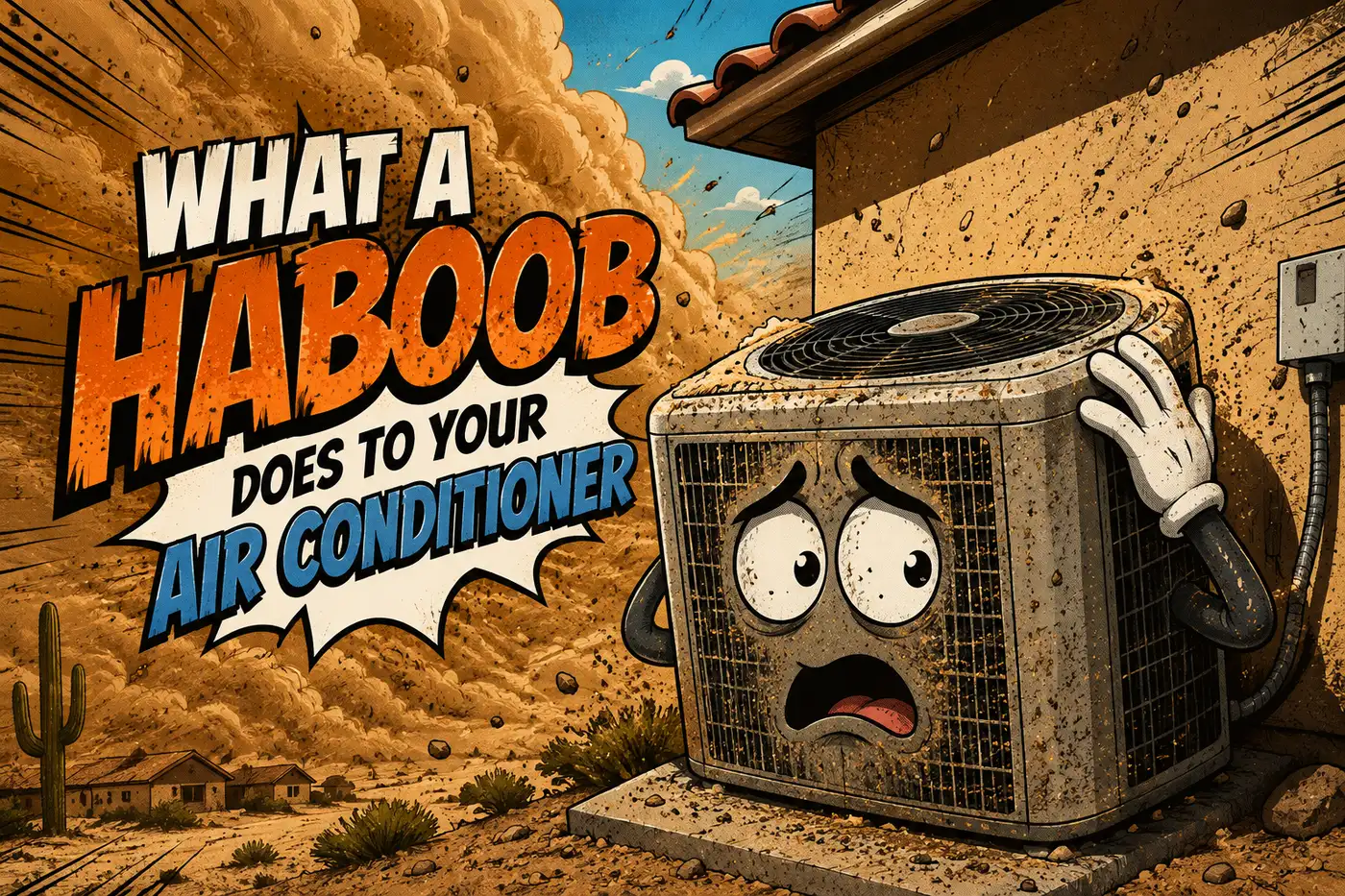
You watched it come in from ten miles out: a rust-colored wall a mile high, moving at highway speed. Half an hour later the sky was blue again, the patio furniture was in the pool, and everything outdoors wore a coat of fine powder. Including your air conditioner, which almost certainly ran straight through the whole thing, breathing that powder the entire time.
What the dust does to the outdoor unit
Your condenser coil works like a radiator. The fan pulls air through thousands of thin aluminum fins, and the heat from inside your house rides out on that air. Haboob dust is not ordinary dirt; it is silt fine enough to sift deep between those fins, and if rain follows the dust, as it often does, it cakes into a crust with the texture of dried grout. A crusted coil cannot get rid of heat. The system compensates by running longer and hotter, your electric bill quietly climbs, and the compressor, the most expensive part in the system, picks up the extra work.What it does indoors
The dust does not stay outside. Leaks on the return side of your ductwork pull attic air, and after a storm the attic is full of freshly delivered dust, straight into the airstream. A filter that had a month of life left will choke in days. And if the ducts leak badly enough, you will be wiping down shelves all week and wondering why. That last one is a duct problem, not a housekeeping problem, and sealing the leaks fixes it at the source.The after-the-storm checklist
First, the outdoor unit. Kill power at the disconnect box mounted on the wall beside it. Then rinse the coil with a garden hose from the top down, gently, the way you would rinse a window screen. Do not blast it. High pressure at close range folds the fins flat and drives grit deeper into the coil, which turns a free rinse into a paid repair. If the water runs off gray for a while and then clear, you have done real good.Second, the filter. Pull it and hold it up to a light. If light passes through, put it back. If it looks like a slab of felt, replace it. After a haboob, this one check catches more trouble than everything else combined, and it costs whatever a filter costs.
Third, listen. Stand next to the outdoor unit while it runs. You know what it sounded like in June. If it is now louder, runs longer, or shuts off and restarts when it never used to, the coil is probably still loaded with dust you cannot see, because most of what a haboob delivers ends up on the inside face of the coil, where a garden hose cannot reach.
When to bring in a pro
A proper coil cleaning works from the inside out, with the panels off and a cleaner that dissolves the mineral crust a hose leaves behind. It is part of our $129 tune-up, along with checking whether the storm's power flickers softened a capacitor. And if the storm broke something outright, there is $50 off any repair booked online.Now the part where we tell you not to spend money: one storm, a careful rinse, a fresh filter, and a system that sounds normal means you are probably fine. Skip the service call. But the Valley averages several of these walls every monsoon, and if your condenser eats three or four a season, an annual cleaning stops being optional. That is the actual argument for a maintenance membership, which starts at $149 a year and puts the cleaning on a schedule so you never have to think about it.
A haboob is fifteen minutes of weather and, left alone, a whole summer of consequences. If your system has not been looked at since the last one rolled through, call (480) 863-5855 or book a tune-up, and we will tell you in one visit whether the storm actually cost you anything.
Need this handled, not just explained?
Same-day service across the Valley, upfront flat-rate pricing, and NATE-certified technicians available 24/7.