Heat pump vs. AC + furnace: the honest Phoenix comparison
The Valley may be the best heat-pump climate in the country, but a gas furnace still has real advantages worth naming. Here's the comparison without the sales pitch.
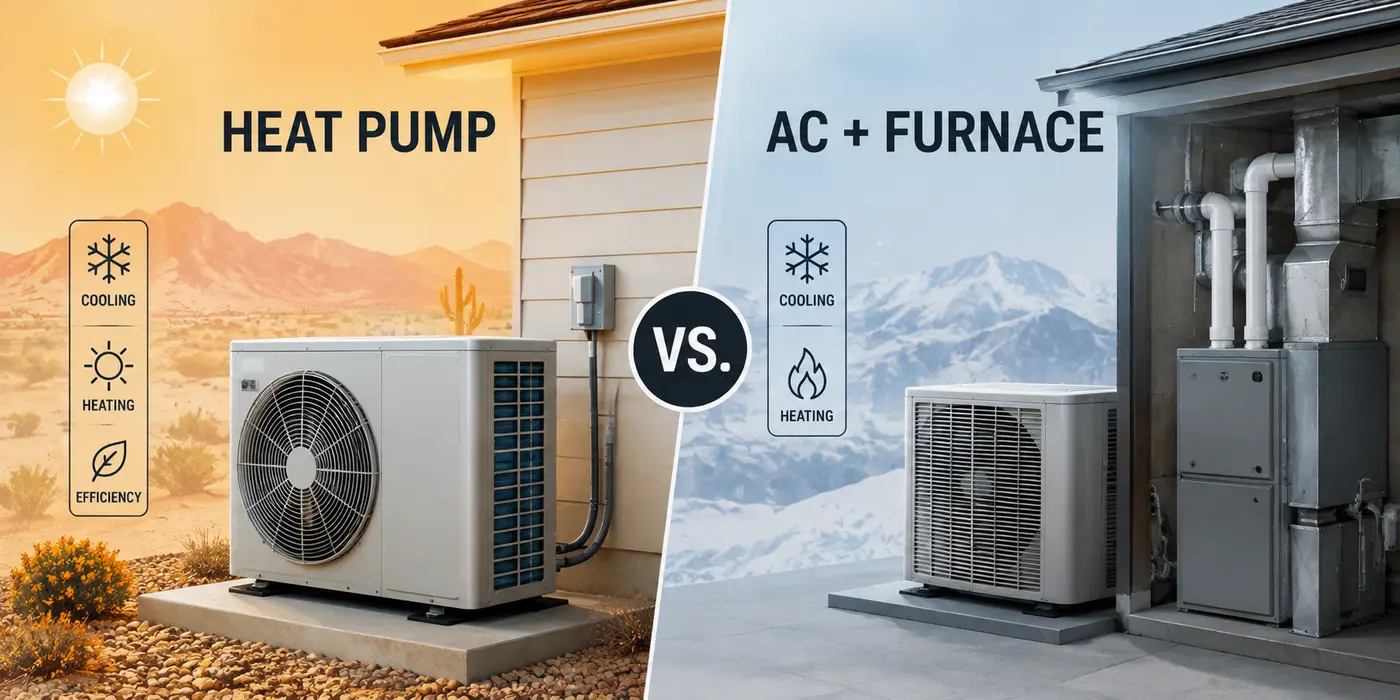
If you're replacing a cooling system in Phoenix, someone will eventually ask whether you've considered a heat pump. It's a fair question with a lot of confused answers attached, most of them written for climates nothing like ours. Here's the comparison the way we'd give it to a neighbor: what a heat pump does well in the desert, where a gas furnace still earns its keep, and how the money actually shakes out.
First, what a heat pump actually is
Strip away the jargon and a heat pump is an air conditioner with one extra part: a reversing valve. In summer it cools exactly the way a conventional AC does — same compressor, same coils, same performance on a 115-degree afternoon. In winter the valve flips the refrigerant cycle around, and instead of pumping heat out of your house, it pulls heat from the outdoor air and moves it inside. Even chilly air holds heat. The machine moves it; it doesn't burn anything to make it.Phoenix might be the best heat-pump climate in America
Heat pumps have one honest weakness: as outdoor temperatures fall, there's less heat to harvest and efficiency drops. In Minnesota that matters. Here it barely registers. A typical Valley winter morning sits in the 40s, our overnight lows rarely hold below freezing, and by noon the system is loafing. A heat pump in Phoenix heats efficiently all winter long without ever leaning on backup electric strips — the exact scenario the technology was built for. The cold-climate compromises you read about online simply don't apply at this latitude.One machine, two jobs
With a conventional setup you own two systems — an AC outside and a furnace in the closet or attic — each with its own parts to fail, its own maintenance, and its own replacement clock. A heat pump is one machine doing both jobs. No gas line, no flue, no combustion safety checks, one piece of equipment to maintain instead of two. Simplicity is an underrated feature.Where gas still wins
Honesty requires this section. A gas furnace blows hotter air at the register — supply temperatures around 120 to 140 degrees, versus roughly 95 to 105 from a heat pump. Both hold the house at whatever the thermostat says, but on a 38-degree morning the furnace feels warmer standing over the vent, and some people genuinely miss that. And if your home is already plumbed for gas with a healthy, mid-life furnace, ripping it out early rarely makes sense. Keeping the furnace and replacing only the AC is a perfectly defensible choice, and we'll tell you when it's yours.The money is where it gets interesting
Heat pumps carry the largest federal tax credit in residential HVAC — up to $2,000 on qualifying equipment — plus utility rebates from APS and SRP stacked on top. A straight AC swap qualifies for far less. And here's the part that surprises people: if your AC and furnace are both nearing the end, a heat pump replaces both for roughly what the two-system swap would cost. Once the credit and rebates land, the heat pump often wins the math outright, not just on principle.Our honest read
If only the AC has died and your furnace is young, there's no shame in a like-for-like replacement — or a straightforward furnace replacement later, when its own time comes. But if both systems are aging out together, which is common since they were usually installed the same week, the heat pump deserves to be the default in this climate, not the alternative. Either way, 0% financing on approved credit means the decision doesn't have to happen all at once on a credit card.We install both, so we have no horse in this race — the right answer for your house wins. Get a free instant estimate or call (480) 863-5855 and we'll run the numbers with you, credits and rebates included.
Need this handled, not just explained?
Same-day service across the Valley, upfront flat-rate pricing, and NATE-certified technicians available 24/7.