It's running. It's just not cooling.
The fan is going, air is moving, and none of it is cold. Four things cause almost all of it — and two of them you can check yourself before you call anyone.
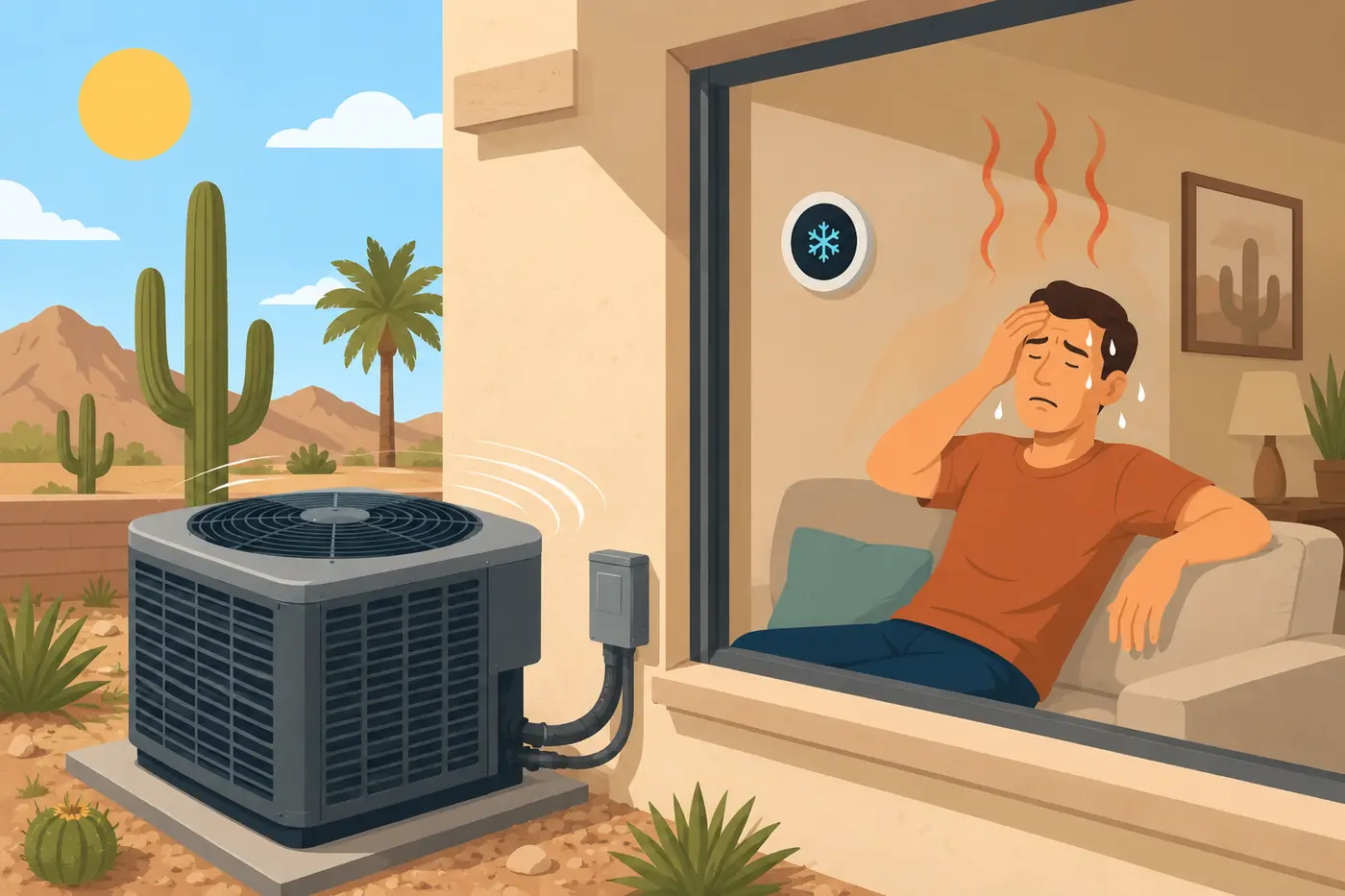
There is a particular kind of dread that belongs to Phoenix in July. You walk past a vent, hold your hand under it, and feel air moving — but it is room temperature. The system is running. The thermostat says 78. The house says 88 and climbing. Nothing is obviously broken, which somehow makes it worse.
Here is the useful thing to know: a system that runs but will not cool is a different problem from a system that will not turn on at all, and it narrows the list considerably. In our experience four causes account for the overwhelming majority of these calls. Two of them you can check in the next five minutes without tools.
Check this first: the filter
A filter thick enough with dust becomes a wall. Airflow across the evaporator coil drops, the coil gets too cold, and the system loses its ability to move heat out of your house. In bad cases the coil freezes solid and the airflow stops almost entirely. Pull the filter out and hold it up to a light. If you cannot see light through it, that is very likely your answer, and a $15 filter fixes it. If it was badly clogged, shut the system off for a few hours to let anything frozen thaw before restarting.Then check the outdoor unit
Walk outside. The big fan on top of the condenser should be spinning and the air coming off it should be hot. If the fan is not turning at all — but the indoor blower is clearly running — you are usually looking at a failed capacitor or contactor. That is the single most common repair we make, it is not expensive, and it is not something to diagnose by hand: there is stored voltage in those components even with the power off. Note what you saw and call.The dirty condenser coil
If the fan is spinning, look at the coil fins wrapping the outside of the unit. Valley dust, cottonwood, and the fine grit that blows in ahead of a storm pack into those fins until the unit cannot dump heat into the outside air. The system runs and runs, pressures climb, and the air at your vents gets steadily less cold. A proper coil cleaning — not a garden hose from the outside, which drives debris deeper — restores it. That cleaning is included in our $129 tune-up.Low refrigerant, which always means a leak
This is the one homeowners guess first and it is genuinely common, but the wording matters. Refrigerant is not fuel and it does not get consumed. If your system is low, it is leaking. Anyone who simply adds refrigerant and drives away has sold you a repair with a built-in expiration date — you will be calling again, probably next summer, probably in July. The honest fix is to find the leak, repair it, and recharge to the manufacturer's specification.What to do while you wait
Close blinds on the sun side of the house. Run ceiling fans — they cool people, not rooms, so only in rooms you are actually in. Do not crank the thermostat down to 60; it does not make the system work harder, it just runs longer. And if anyone in the house is elderly, very young, or has a heart or lung condition, treat indoor heat as the medical issue it is and tell us that when you call so we can prioritize.Two of those four causes are caught in advance by an annual inspection, which is the entire unglamorous argument for maintenance. If yours is already down, call (480) 863-5855 — we answer around the clock — and take a look at $50 off any repair before you book. If the diagnosis turns out to be a system at the end of its life, we will show you the math on replacement honestly, in daylight, with no pressure.
Need this handled, not just explained?
Same-day service across the Valley, upfront flat-rate pricing, and NATE-certified technicians available 24/7.