
Cave Creek has more ways to heat a house than most towns have stoplights
Electric, natural gas and propane all have a real share here, on big lots with long dirt driveways. So our first question is what's actually running in your house.
- Propane, gas and electric
- Heat pump service
- Dust and critters
- Open 24/7
Schedule today — we’re here 24/7.
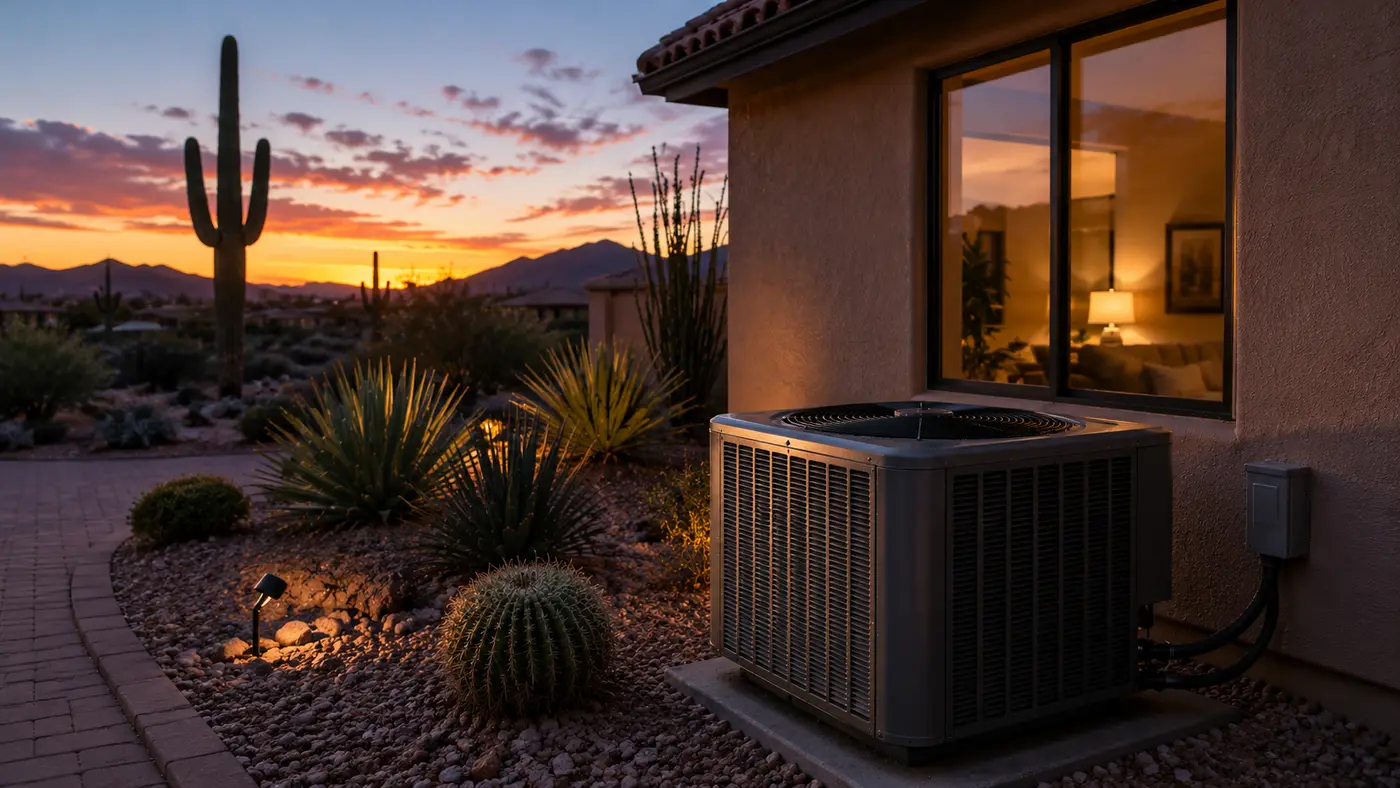
Cave Creek was settled in 1870 by soldiers from Fort McDowell, and it hasn't entirely gotten over it. It's a town of horse properties, boots on Saturdays and a main drag that takes its Western theme seriously. It also sits at a higher elevation than the Valley floor, so it's cooler than Phoenix, a fact locals mention often and accurately.
The house under that big sky might heat with anything. 54% use electricity, 33% natural gas, and 6% propane, one of the highest propane shares in the Valley. Most are owner-occupied (95%) and 84% are detached, with 4% manufactured. Before anyone quotes you, they should find out what you've got.
- 1998
- Median home built
- 84%
- Single-family detached
- 95%
- Owner-occupied
- 8%
- Seasonal homes
Built slowly, on a lot of land
The median home dates to 1998, and 25% went up since 2010, more than in many older towns. The town covers about 38 square miles and has about 2,859 housing units, so homes sit far apart. With a population this small, Census figures have a wider margin of error.
When the homes were built
What heats them
- 54% electricity
- 33% natural gas
- 6% propane
- 7% other or none
U.S. Census Bureau, American Community Survey 2020–2024, 5-year estimates. Estimates carry a margin of error, wider in small communities. Electric heat includes both heat pumps and electric furnaces; the Census doesn’t separate them.
What Cave Creek homes ask of an HVAC system
Three fuels, three checklists
Propane needs a tank and regulator check. Natural gas needs a furnace tune-up. Electric heat needs someone to see whether expensive backup strips are running. Find out what you have before scheduling service.
Dust, rodents and horse country
Open desert and stables mean more dust and hay in the coil. Packrats like an idle unit's wiring. Keep a clear space around the equipment, and rinse the coil gently. See our haboob notes.
Remote lots and long service runs
Equipment far from the house and long electrical runs can complicate a replacement. Ask how the plan handles them. A mini-split can also be a tidy way to cool a casita or a tack room.
Around Cave Creek
Old Cave Creek and the town core
Along Cave Creek Road, older homes and storefronts mix with newer builds. Some homes have been added onto repeatedly, so what serves which room isn't always obvious.
Tonto Hills and north of town
Toward the Tonto National Forest, lots get bigger and the desert gets closer. Higher ground means cooler nights and more use of your heat.
Black Mountain and Elephant Mountain
Black Mountain marks the south of town at 3,398 feet, Elephant Mountain the north at 3,926 feet. Homes on these slopes may place equipment on tight pads, so plan access before the old unit comes out.
Horse properties
Plenty of lots keep animals, which brings hay dust and flies to the outdoor unit. Keep feed and hay away from it, and consider a tune-up that includes a real coil cleaning.
What's actually heating your Cave Creek house?
It's a fair question, and many owners who inherited a system don't know the answer. Look at the indoor unit and your bills. A propane bill means a tank-fed furnace. A gas bill means a gas furnace. If you've got neither, it's electric: either a heat pump or resistance strips.
It matters since each one fails differently and costs differently to run. If you're on propane and thinking of switching, a heat pump may reduce your winter fuel bills, though it's worth checking your panel first.
Before you call anyone
- Find your fuel: propane tank, gas meter or neither
- Check the propane level before winter
- Test carbon monoxide alarms
- Clear brush two feet back from the outdoor unit
What Cave Creek customers say
Great service and very informative. Highly recommend
What a new system costs in Cave Creek
Fuel type shapes the quote as much as size does. Keeping propane, moving to a heat pump, and replacing a gas furnace are three different jobs. Remote equipment or long line runs can add labor. We'll price it flat, in writing, once we've seen it.
We charge the same way across the Valley: a flat-rate price before any work starts. Our $129 tune-up, $50 off any repair and 0% financing on approved credit apply in Cave Creekas they do everywhere else. The estimator gives you a range in about a minute. It isn’t a quote, because nobody has seen your attic yet.
Step 1 of 3
How big is your home?
Power bills and rebates in Cave Creek
Check your bill for your electric utility. Out here, it's better to read it than to guess.
The name at the top of your power bill decides which programs you can use.
SRP lists rebates of up to $1,125 on a new energy-efficient AC, up to $400 for duct testing and repair, and up to $600 for insulation, plus up to $100 for enrolling a smart thermostat. It accepts claims on work finished within the past six months. Check SRP's current terms before you count on the money.
APS is a different story. In December 2025, the Arizona Corporation Commission zeroed out the budget for its residential home-improvement incentives, effective January 1, 2026. The Cool Rewards program, which pays customers to let APS nudge a smart thermostat during peak demand, survived.
One thing to cross off the list: the federal energy efficient home improvement credit covers improvements made through December 31, 2025. A system installed today doesn't qualify, whatever an old flyer says.
Programs checked November 2026. They change, so confirm before you buy.
Permits for HVAC work in Cave Creek
Inside town limits, permits go through the Town of Cave Creek. Some properties with a Cave Creek mailing address actually sit in Phoenix, Scottsdale or unincorporated county land, so check your parcel before you call.
Town of Cave CreekWhoever does the work should hold an Arizona Registrar of Contractors license. Bleuwave’s is ROC #340022, and you can look any contractor up at roc.az.gov.
Where Cave Creek homeowners usually start
Cave Creek service guides
This month's specials
Book online to claim. Stack with 0% financing on approved credit.
Cave Creek HVAC questions
Straight answers, no runaround. Don’t see yours? Our team is a phone call away, around the clock.
Often, yes. You'll want to confirm your electrical panel can handle it and that your ducts are suitable. Compare your propane bills against electric rates first, and consider what else in the house uses propane.
Mailing addresses don't follow town lines. A Cave Creek address may fall under Phoenix, Scottsdale or Maricopa County. Your property tax bill will show the jurisdiction, and permits follow that.
Keep feed and bedding well away from the unit, and leave a couple of feet clear on all sides. With the power off, rinse the coil gently from time to time. A spring tune-up should include a real cleaning.
Yes, thanks to its elevation. That means your AC gets a slightly easier summer and your heat a harder winter. Don't undersize either.
Sources
- U.S. Census Bureau, American Community Survey 2020–2024 (Cave Creek)
- Wikipedia, Cave Creek, Arizona
- Town of Cave Creek
- SRP, residential rebates
- Arizona Corporation Commission, December 3, 2025 meeting highlights
- KJZZ, regulators scale back APS efficiency incentives
- IRS, Energy Efficient Home Improvement Credit
Page updated 2026-11-07. Written for homeowners; every home still needs its own look before anyone quotes it.
Book HVAC service in Cave Creek
Book online or call now — same-day appointments available across the Valley.
- 24/7 emergency service
- Upfront, honest pricing
- Licensed, bonded & insured