
Central AC Replacement
The outdoor condenser and the indoor coil are one machine. Replacing half of it is how Phoenix homes end up with new equipment and old problems.
- Condenser and coil replaced as a match
- Why mismatched halves fail early
- Line set, pad and drain checked too
- Schedule it before the first 110
Schedule today — we’re here 24/7.
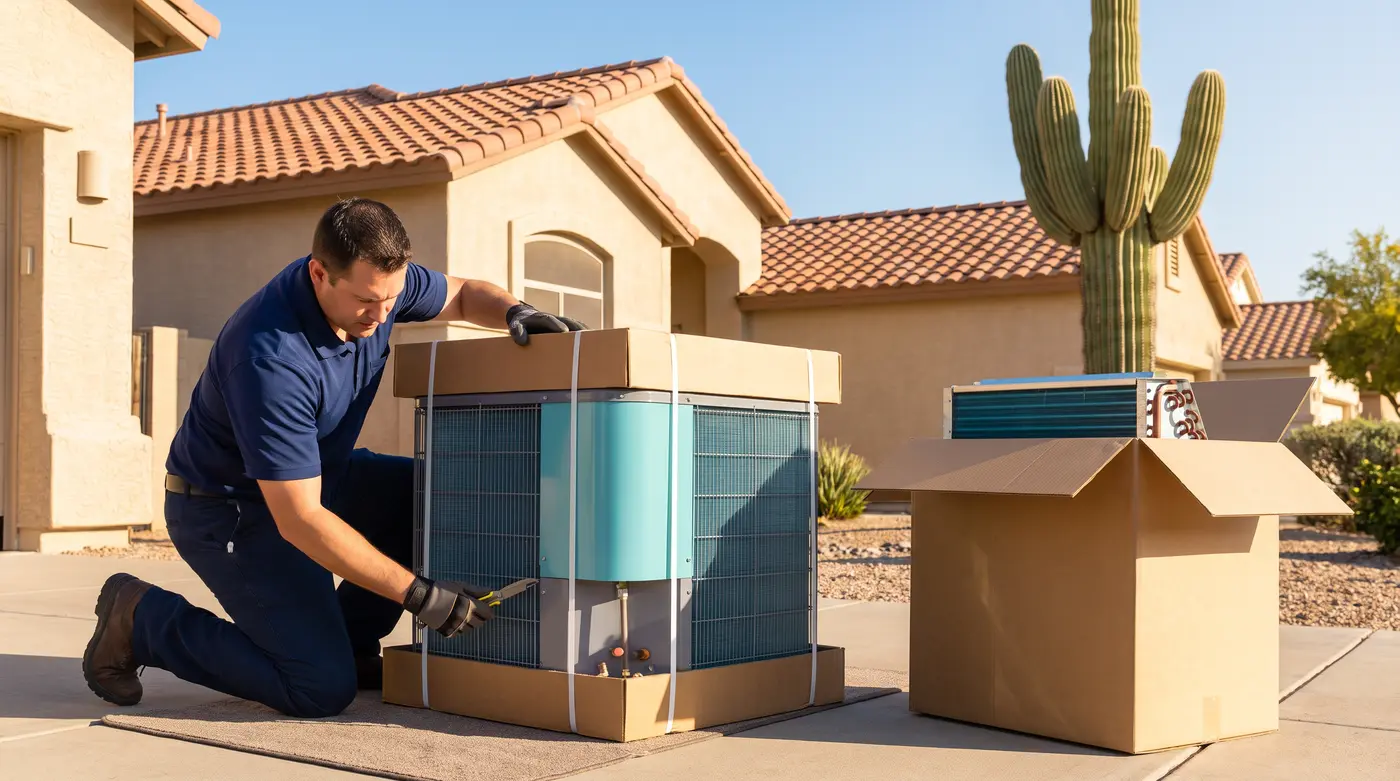
What is actually being replaced
A central split system in a Valley home has two halves. The condenser sits outside on a pad, or on the side-yard gravel where the previous owner left it, and holds the compressor, the outdoor coil and the fan. The evaporator coil sits inside, usually above the furnace or inside the air handler in the attic, and does the actual cooling. The refrigerant line set connects them. Central AC replacement means replacing the condenser and the evaporator coil together, then dealing with whatever the line set, pad, drain and electrical turn out to need. It does not necessarily mean replacing the furnace or air handler, though the age of that equipment belongs in the conversation. If you are still deciding whether the old unit has another summer in it, the repair-versus-replace framework is the place to start. This page assumes the answer is replace.Matched systems, and why mismatches fail
Every outdoor unit is engineered to work with a specific range of indoor coils. Match them and you get the efficiency rating on the label, the capacity the load calculation asked for and the warranty the manufacturer promised. Mismatch them and you get none of those, plus a set of problems that show up slowly. A new condenser bolted to a fifteen-year-old coil built for a different refrigerant, or an undersized coil from a cheaper swap, typically means:- Lower real-world efficiency than the rating suggests, so the bills do not drop the way you were told.
- Poor refrigerant control, with the compressor running outside its design pressures on 112-degree afternoons.
- Freeze-ups, short cycling or a coil that never quite keeps up with the west-facing rooms.
- Warranty claims denied because the system was never a system.
Efficiency tiers without the brochure
Replacement equipment comes in three broad tiers. Single-stage runs at full capacity or not at all; it is the simplest, the least expensive to buy and the least gentle on comfort and time-of-use bills. Two-stage adds a low setting that handles mild days and shoulder seasons, running longer and quieter, which also pulls more monsoon humidity out of the air. Variable-speed equipment modulates across a wide range, holding a setpoint with small adjustments instead of on-off swings, and tends to shine on APS and SRP time-of-use plans where afternoon draw is what you pay for. Which tier makes sense depends on how long you will own the home, how the ducts are built and how much of your bill is peak-hour cooling. The split-system equipment page compares them without the marketing.The line set, the pad and the small parts
The line set is the copper pair between the two halves. If the new equipment uses a different refrigerant, or the old lines are undersized, kinked, buried in slab or have been open to the atmosphere, they get replaced or, where replacement is impractical, flushed and pressure-tested. The pad is either fine, sinking or gone; a level pad keeps the compressor oil where it belongs. The disconnect, whip, breaker and surge protection are checked against the new unit's electrical requirements. The condensate drain and its safety switch are cleared or replaced, because a clogged drain in an attic over a Chandler master bedroom is a ceiling repair waiting to happen. None of this is glamorous. All of it decides whether the equipment lasts.What changes the scope
- Coil access. An attic coil above a scuttle hole is more work than one in a garage closet.
- Refrigerant transition. Moving off R-22 or older R-410A equipment generally adds line set and coil work.
- Duct findings. Sealing, a larger return or a resized trunk may be needed for the new unit to breathe.
- Electrical. Panel space, breaker sizing and disconnect condition.
- Tier and accessories. Variable-speed equipment, communicating thermostats, filtration.
- Air handler or furnace age. Replacing the indoor unit at the same time is sometimes wise and sometimes waste; the evaluation says which.
Questions to ask any bidder
- Is the evaporator coil included and matched to this condenser by the manufacturer?
- Are you replacing or flushing the line set, and how will you verify it?
- What is the new pad, and is the disconnect being replaced?
- Did you measure static pressure, and what did you find?
- Which tier is this, and what would the next one up change in August?
- Who pulls the permit and schedules the inspection?
Timing, and why April is better than July
Systems fail when they are working hardest, which in the Valley means the first stretch of 110-degree days. That is also when every contractor's schedule is full, equipment stock is thinnest and the decision gets made in a hot house at nine at night. If your system is old enough that replacement is likely within a year or two, the calm months from October through April give you a proper load calculation, a choice of tiers and an installation date you chose. A spring maintenance visit is the honest way to find out which category you are in. And whatever this page has told you, it cannot size your system or confirm the coil is the problem. That takes an on-site evaluation, which is where our installation process begins.Central AC Replacement: common questions
Straight answers, no runaround. Don’t see yours? Our team is a phone call away, around the clock.
Sometimes, if the coil is recent, uses the same refrigerant and appears on the manufacturer's match list for the new condenser. In most Phoenix replacements it is not, because the coil has seen the same fifteen summers as the condenser. Reusing it usually costs the efficiency rating, the warranty and eventually the new compressor.
Not always. If the indoor unit is much younger than the condenser and its blower can move the air the new system needs, it can stay, with a new matched coil. If it is the same age, replacing both at once avoids a second labor bill and a second attic visit in a few years. The on-site evaluation weighs the blower, the age and the access.
Not always, but often. Lines that are the wrong size for the new equipment, kinked, corroded or contaminated with old oil get replaced. Lines buried in a slab or run through finished walls may be flushed and pressure-tested instead when replacement is impractical. The estimate should say which approach applies and why.
For a block-and-stucco home you plan to keep for years, two-stage or variable-speed equipment tends to earn its premium on time-of-use plans and in comfort through monsoon season. For a short ownership horizon or a rental, single-stage can be the rational choice. The staging explainer lays out the tradeoffs, and the load calculation and duct findings settle it.
A straightforward pad-and-attic swap is typically a single working day. Difficult coil access, duct corrections, electrical upgrades or a line set replacement extend it. Your written estimate should state the planned duration for your specific scope rather than a generic promise.
Only if the equipment was the cause. A hot room at four in the afternoon is more often a duct, return or insulation problem, and a new condenser will not change it. Ask the bidder what they found in the ducts. If that room is not addressed in the scope, it will still be hot in August, and our hot and cold room page covers the actual fixes.
You can, and many people do, but it puts the decision in July with no leverage and no time. Replacing on your schedule in the cooler months gives you a load calculation, tier options and a date you chose. If a maintenance visit shows the compressor is weak or the coil is leaking, that is the signal to plan rather than wait.
Central AC Replacement throughout the Phoenix area
Same-day appointments across Maricopa and Pinal counties. Pick your city for local pricing pages, reviews and service details.
Replace the system, not half of it
Book an on-site evaluation for a load calculation, a matched-equipment quote and a date on the calendar before summer.
- 24/7 emergency service
- Upfront, honest pricing
- Licensed, bonded & insured