
What Size Mini-Split Do I Need for My Garage?
The square-footage calculator will give you a number in four seconds. In a Phoenix garage, that number is usually wrong in one direction or the other. Here is what actually decides the size.
- Square-footage rules ignore the roof
- Insulation changes the answer most
- West sun and door leaks add load
- A load calculation settles it
Schedule today — we’re here 24/7.
The Short Answer
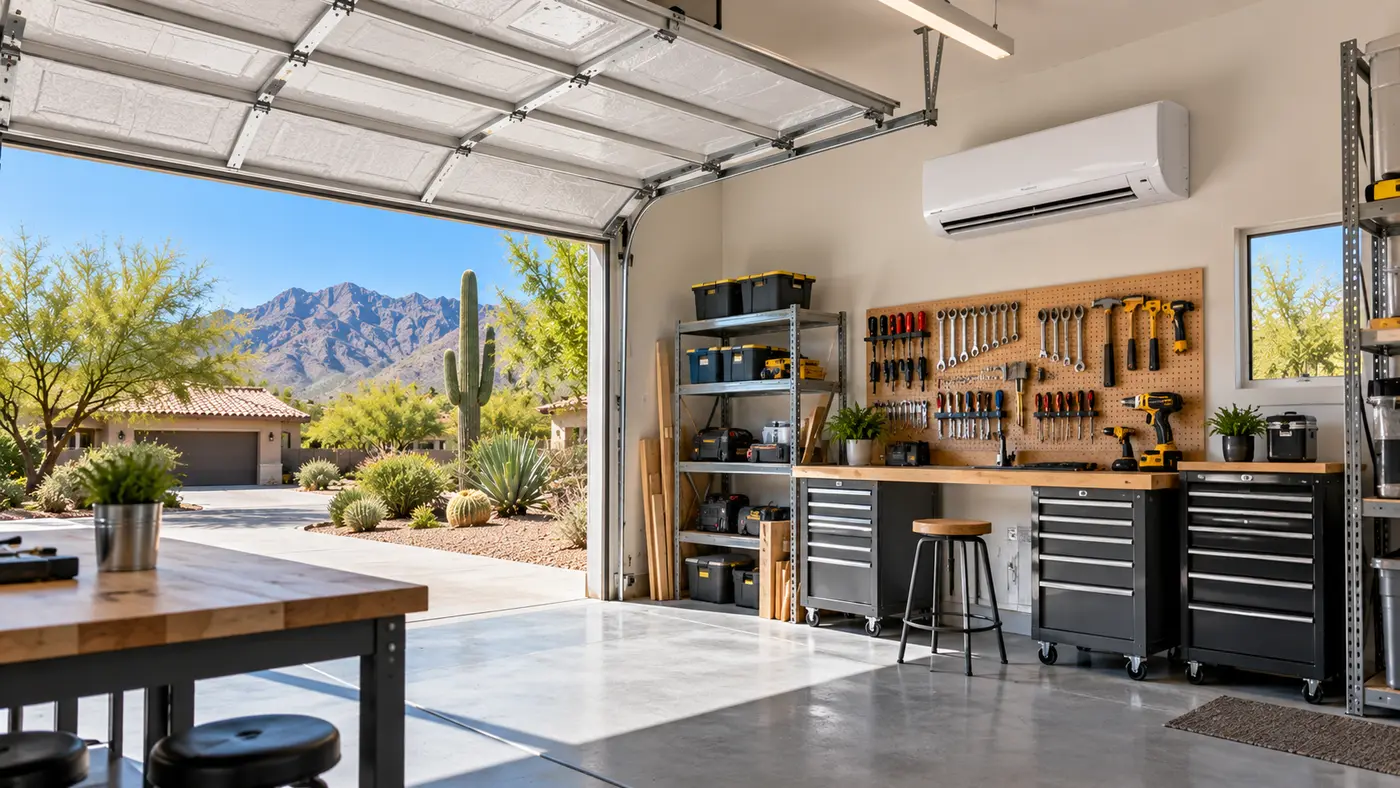
There is no honest answer from square footage alone. Two garages of identical size in the same Gilbert subdivision can need different mini-splits, because one has an insulated roll-up door and R-38 over the ceiling and the other has a bare steel door facing west and nothing over the drywall but a 155-degree attic. The rule of thumb gets you to the hardware store aisle, not to the right unit. Sizing a garage mini-split is a load calculation, and that requires someone standing in the garage with a tape measure and a plan for what the room will become. If you are still deciding whether the garage should be conditioned at all, start with our garage cooling and heating guide and come back.Why BTU Rules of Thumb Fail in Phoenix
Online calculators multiply floor area by a fixed BTU figure. That figure was developed for a finished, insulated living space in a temperate climate with a normal ceiling and a door that closes. A Phoenix garage violates every assumption on that list.- The roof is the problem. A garage ceiling often has thin or no insulation. Heat radiates straight down from the attic all afternoon and well past sunset.
- The big door is a hole. An uninsulated sectional door leaks air around every panel and absorbs sun like a griddle.
- Slab and walls store heat. Block and stucco soak up a 112-degree day and release it into the room overnight.
- Ceiling height is not counted. Ten-foot and twelve-foot garage ceilings add volume the calculator never sees.
The Five Things That Actually Set the Load
Insulation, first and always
Ceiling insulation is the single largest lever. A garage with a properly insulated ceiling and door can sometimes land a full size class smaller than the same garage bare. This is why we discuss attic insulation before we discuss equipment. Spending on insulation is often the cheapest capacity you will ever buy.Sun exposure and orientation
A west-facing door in Peoria takes the worst of the afternoon. South-facing walls with no shade run hot for more hours. Any window, even a small one, changes the math.Door and envelope leakage
Weatherstripping, a bottom seal, and an insulated door panel matter more than most homeowners expect. A garage that cannot hold air cannot hold cold.Ceiling height and volume
Tall ceilings for a lift or storage racks mean more air to condition and more surface area radiating heat.What happens inside
A parked car that arrives hot, a chest freezer, a welder, a treadmill and the person on it, a water heater: internal gains add up. A garage gym is a different load than a garage workshop.How a Load Calculation Works
A proper calculation measures wall and ceiling area, insulation values, door and window construction, orientation, air leakage and internal gains, then produces a cooling and heating load in BTUs per hour. That load, not the floor area, picks the unit. Mini-splits come in nominal capacity classes, and the goal is a unit whose rated output at Phoenix design temperatures, not at the milder test conditions printed on the box, covers the load with modest margin. Inverter-driven mini-splits forgive small sizing errors better than fixed-speed equipment because they modulate, but they do not forgive a bare ceiling. Read more about how the equipment itself works on our ductless mini-splits explained page.When Not to Spend the Money Yet
If the garage door is uninsulated and the ceiling has nothing above it, buying a mini-split today means buying a bigger one than you need and paying to run it forever. Fix the envelope first. If you only need the garage tolerable for an hour on Saturday mornings, a fan and an early start may be enough, and we will say so. And if you already have an older mini-split out there that is struggling, our repair-vs-replace guide walks through whether the unit is undersized, neglected or simply done. Once a unit is in, a seasonal filter and coil check keeps it at rated capacity; our maintenance guide explains what that visit covers.Garage Mini-Split Sizing Throughout the Phoenix Area
We size and install garage mini-splits in Chandler, Gilbert, Mesa and Peoria. Every install includes a written scope and a flat-rate quote before work begins. Details on how we price and finance are on our estimates and financing page. A web page cannot size your garage. A technician on site can, in under an hour.What Size Mini-Split Do I Need for My Garage?: common questions
Straight answers, no runaround. Don’t see yours? Our team is a phone call away, around the clock.
You can, but in Phoenix it will usually miss. Those calculators assume an insulated living space with a normal ceiling and no twenty-foot steel door. A load calculation that measures your actual garage is the only way to land on the right capacity class.
Often it changes the size class outright. Ceiling insulation and an insulated door cut the load enough that a smaller unit works and runs less. We recommend addressing insulation before buying equipment.
It runs continuously through the afternoon and never reaches setpoint on a 112-degree day. The compressor logs long hours, the room stays warm, and you conclude mini-splits do not work. The equipment was fine; the sizing was not.
No. An oversized unit cools the air quickly, shuts off, and never runs long enough to pull moisture out during monsoon season. Short cycling also wears components faster. Inverter mini-splits soften this, but they cannot erase a large sizing error.
Yes. A twelve-foot ceiling adds volume and wall area the floor-area rule ignores. Tall garages with storage racks or a vehicle lift routinely need more capacity than their footprint suggests.
Usually. A west-facing door takes the afternoon sun at the hottest part of the day, and an uninsulated steel door conducts that heat directly into the room. Orientation is one of the inputs in the load calculation.
Most garage mini-splits are heat pumps and handle Phoenix winters easily. The cooling load nearly always dominates, so a unit sized for July will have heating capacity to spare in January.
Typically under an hour. We measure the garage, note insulation and door construction, ask how you plan to use the space, and deliver a flat-rate quote in writing. There is no charge to ask for an estimate.
Garage Mini-Split Sizing throughout the Phoenix area
Same-day appointments across Maricopa and Pinal counties. Pick your city for local pricing pages, reviews and service details.
Skip the Calculator. Get a Load Calculation.
A Bleuwave technician measures your garage, checks the insulation and door, and quotes a flat-rate install before any work begins. Call (480) 863-5855 or request an on-site evaluation.
- 24/7 emergency service
- Upfront, honest pricing
- Licensed, bonded & insured