
Should I Air Condition My Garage?
Sometimes yes, often not yet, and occasionally no. An honest walk through who benefits, what it takes to run, and the cheaper options worth trying first.
- Depends on hours of use, not square feet
- Insulate before you condition
- Running cost tracks the envelope
- Fans and swamp coolers have a place
Schedule today — we’re here 24/7.
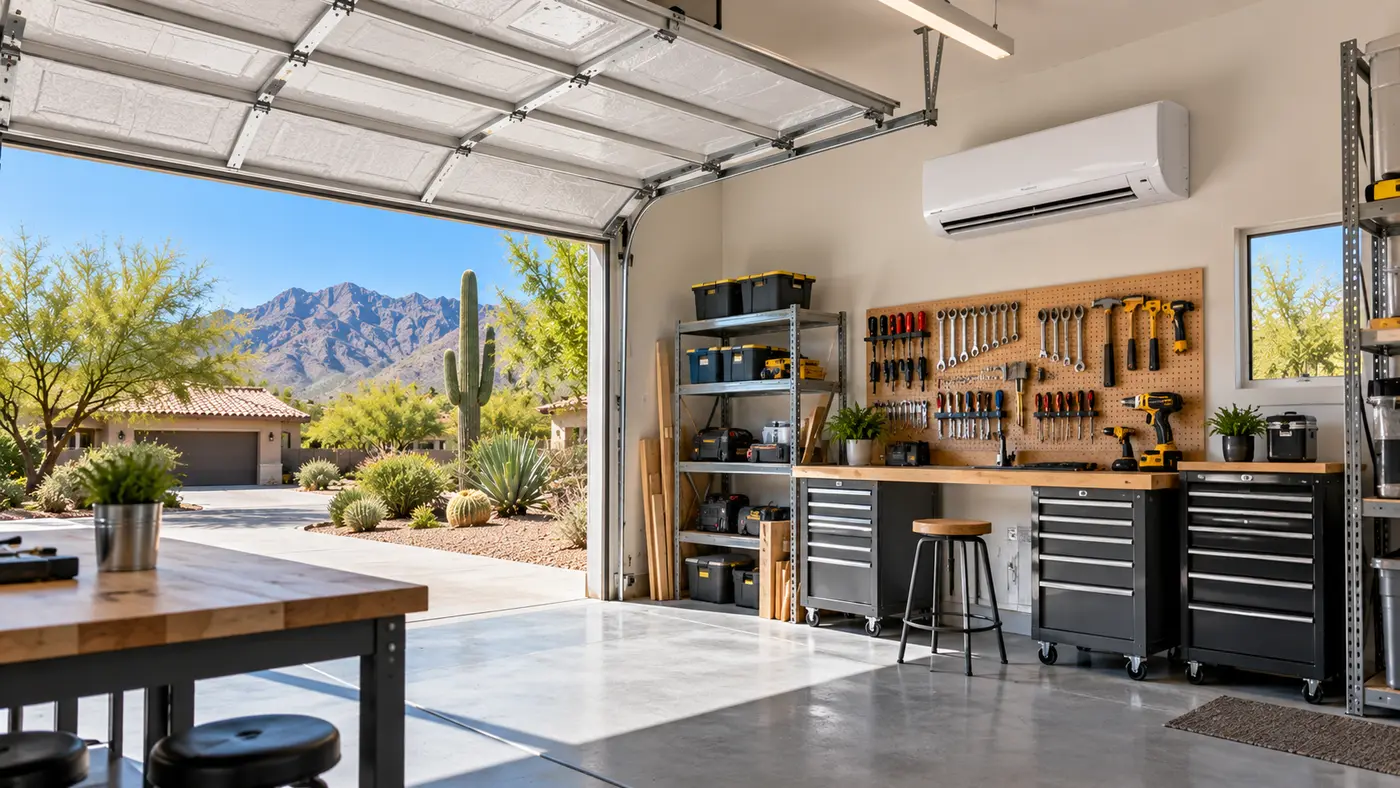
Start With the Hours, Not the Heat
Every Phoenix garage is hot. That is not the question. The question is how many hours a week a person is actually in it, doing something that heat makes miserable or impossible. A garage that stores a car and a lawn mower does not need conditioning. A garage where someone lifts weights five mornings a week, runs a woodshop on weekends, or keeps a second refrigerator and a stock of paint and finishes that should not bake at 130 degrees is a different room. Be honest about the hours. If the answer is fewer than a few per week, the money is better spent elsewhere in the house, and our broader garage cooling and heating guide covers the lighter options.Who Actually Benefits
- Garage gyms. A body producing its own heat in a 110-degree room is the clearest case for cooling.
- Workshops and hobby spaces. Woodworking, finishing, electronics, brewing: work that takes hours and involves materials that dislike heat.
- Home offices and studios carved out of a garage bay, especially where a lease or HOA rules out a room addition.
- Storage that matters. Wine, film, instruments, tools with batteries, a freezer that runs hard in summer.
- Homes where the garage shares a wall with a bedroom. A cooler garage means a cooler bedroom wall and a system in the house that works a little less.
What It Costs to Run, in Plain Terms
We do not quote operating numbers on a web page, because they depend entirely on your envelope, your setpoint, your hours and your utility plan. What we can say: a conditioned garage with an uninsulated door and a bare ceiling is one of the most expensive rooms per square foot to cool in the Valley, because the load never stops. The same garage with an insulated ceiling and door, set to a modest temperature only during the hours it is used, runs a fraction of that. On APS and SRP time-of-use plans, a garage that pre-cools in the morning and coasts through the peak window costs noticeably less than one fighting the 4 p.m. sun at full tilt. The envelope decides the bill, not the equipment.Insulation Is the Prerequisite, Not the Upgrade
Do not condition a garage you have not insulated. An insulated garage door, weatherstripping and a bottom seal, and insulation above the ceiling turn the garage from an oven into a room. Skip this step and any cooling equipment you buy will be oversized, overworked and overpriced to run. Our attic insulation page covers the ceiling side. Do the door first if you can only do one.Alternatives Worth Trying First
Ventilation
A garage that vents its hottest air at the ceiling and pulls in cooler air from a shaded side can drop several degrees on its own. It will not make July comfortable. It will make May and October survivable, which for many people is the whole point.Evaporative cooling
The desert's oldest trick still works in a garage, especially one with the door cracked for exhaust. Portable and window evaporative units are inexpensive to run and shine in the dry months. They lose their edge during monsoon humidity and add moisture to the room, which matters if you store paper, tools or finishes. Our evaporative coolers page explains the trade-offs.Shade and reflectivity
A shade structure over a west-facing door is not glamorous. It works.Refrigerated cooling
When the hours are real and the envelope is fixed, a ductless mini-split is the usual answer. It cools and dehumidifies, heats in winter, and does not touch the house system. Never extend the home's ductwork into a garage; code treats the garage as a separate space for good reason, and your main system was not sized for it.When We Will Tell You Not to Do It
If you are in the garage an hour a week, no. If the door is uninsulated and you are not willing to fix it, not yet. If the garage system is really a workaround for a house that cannot keep up, fix the house first; our repair-vs-replace guide is the place to start that conversation, and a maintenance visit on the main system is often the cheaper first move. If the budget is the obstacle rather than the logic, financing on approved credit exists and is explained on our financing page.Garage AC Throughout the Phoenix Area
We evaluate and cool garages in Phoenix, Scottsdale, Tempe and Glendale. A web page can lay out the logic; it cannot tell you whether your garage envelope is ready or what size unit it needs. An on-site evaluation can, and comes with a flat-rate quote before any work begins.Should I Air Condition My Garage?: common questions
Straight answers, no runaround. Don’t see yours? Our team is a phone call away, around the clock.
Usually only if those weekend hours are long and the work is heat-sensitive. For a few hours of light use, a fan, an early start and a shaded door may be enough. We will say so on site rather than sell you equipment you do not need.
No. Building code separates garage air from living space for good reasons, and your home's system was not sized to carry the garage load. A separate unit, typically a ductless mini-split, is the correct approach.
It can help a little when the garage shares a wall with a bedroom or the living room, because that wall stops radiating heat inward. It will not pay for itself that way. Cool the garage for the garage's sake, not as an efficiency strategy.
You do not have to, but you will regret skipping it. An uninsulated garage needs a larger unit, runs it longer, and costs more every month for as long as you own the house. Insulate the door and ceiling first.
In April, May, June, September and October, often yes, especially with the door cracked for exhaust. During monsoon humidity in July and August, it loses most of its effect. It is a good fit for shop use that pauses in the wettest weeks.
On APS and SRP time-of-use plans, running the garage unit during off-peak hours and coasting through the afternoon peak keeps the cost manageable. An insulated garage holds its temperature long enough to make that strategy work; a bare one does not.
Window units need a window or a wall opening and tend to be noisy; portable units exhaust through a hose and are inefficient in extreme heat. Both can work for occasional use. For daily use, a mini-split is quieter, more efficient and heats in winter.
Request an on-site evaluation. We look at the door, the ceiling, the orientation and your actual hours, then tell you whether to insulate, ventilate, evaporate or refrigerate, with a flat-rate quote if equipment makes sense. Start with an estimate request.
Garage Cooling Evaluation throughout the Phoenix area
Same-day appointments across Maricopa and Pinal counties. Pick your city for local pricing pages, reviews and service details.
Insulate, Ventilate, or Refrigerate? Let Us Look.
An on-site evaluation from Bleuwave settles the question in an hour, with a flat-rate quote in writing if equipment is the answer. Call (480) 863-5855 to schedule.
- 24/7 emergency service
- Upfront, honest pricing
- Licensed, bonded & insured