
How to Cool a Garage Gym in Phoenix
The room is 110 degrees and you are about to add a furnace of your own. Here is how to size, ventilate and dehumidify a garage gym so the workout is the hard part.
- Your body is part of the load
- Size the mini-split for the workout
- Move air, then cool it
- Sweat is a humidity problem
Schedule today — we’re here 24/7.
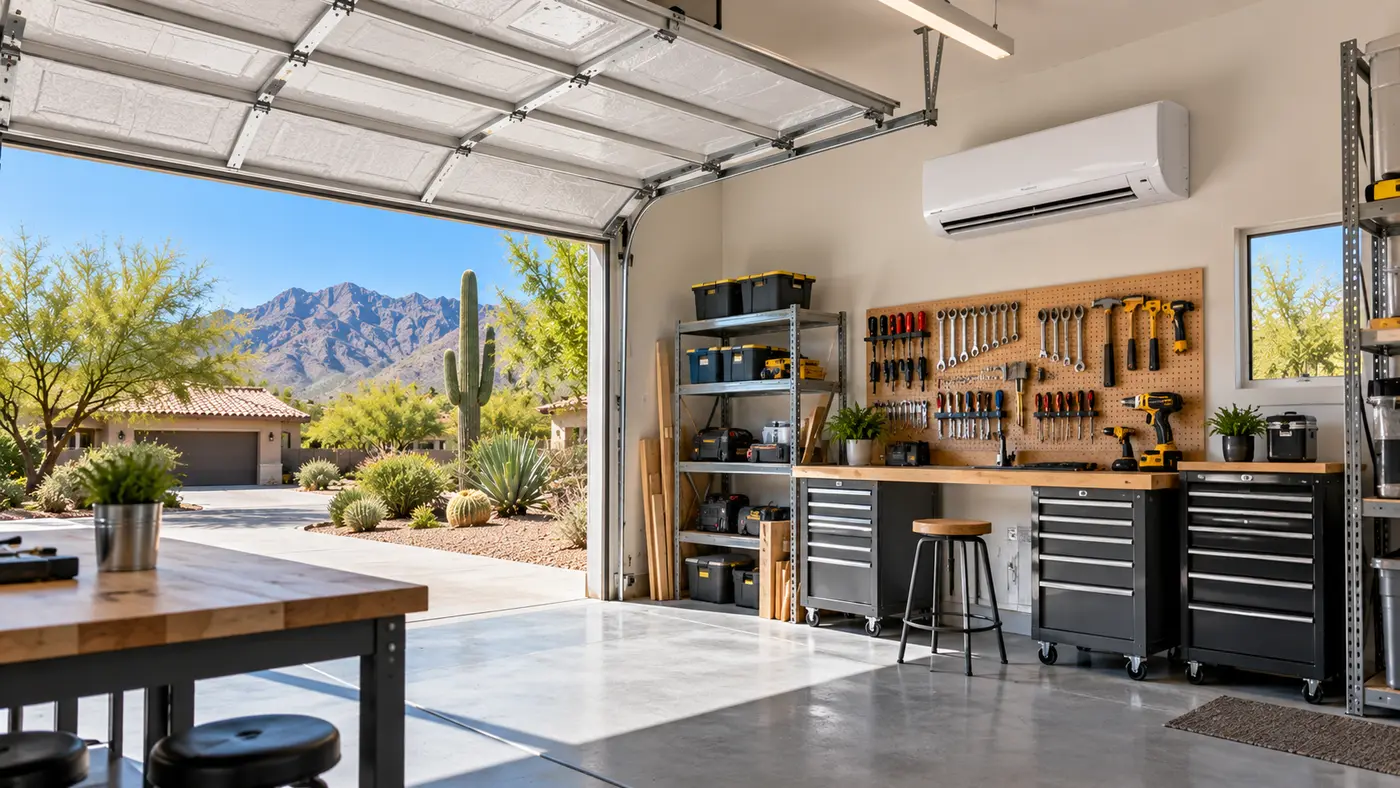
Two Heat Sources, One Room
A garage gym in Phoenix is a special case of the general garage problem, and the difference is you. A person working hard gives off several times the heat of a person sitting still, and that heat goes straight into a room that is already absorbing a 112-degree afternoon through an uninsulated door and a 155-degree attic. Add a treadmill motor, a fan and a partner, and the internal load rivals a small kitchen. Start with the general principles in our garage cooling and heating guide, then read this page for the gym-specific corrections.Insulation and Flooring Come First
A gym is the strongest argument for insulating the garage before buying equipment. Rubber flooring helps more than most people expect: it breaks the thermal connection to a slab that has soaked up heat all day and stops the floor from radiating upward while you are on it. Insulate the door, seal the perimeter, and put insulation above the ceiling. Do this first, because the equipment size depends on it.Sizing the Mini-Split for a Workout
The floor-area calculators fail in every garage; they fail worse in a gym, because they do not know you are in there. A proper load calculation adds the occupants at exertion, the equipment, the lighting and the fans to the envelope losses, then sizes a unit whose output at Phoenix design temperatures covers the total. That usually lands a gym one capacity class above what the same garage would need as a workshop. An inverter-driven mini-split is the right tool here: it ramps up when you start the session and settles down when you leave, instead of cycling on and off. We go deeper on the sizing inputs in what size mini-split for a garage, and on the equipment itself on our ductless mini-split service page.Where the indoor unit goes
Mount it where the supply air crosses the workout area without blasting directly onto the platform. Air moving across skin feels cooler than the thermostat reads, which lets you run a higher setpoint. Keep it away from the door and clear of racks where a dropped bar could reach it.Airflow Before Cooling
Air movement is the cheapest comfort in the room. A high-velocity fan aimed across the workout zone can make a given temperature feel several degrees cooler and lets the mini-split hold a higher, cheaper setpoint. It also keeps cold air from pooling at the floor and hot air from stacking at the ceiling, where the mini-split's return is. Run the fan during the session. Turn it off after; a fan in an empty room only adds motor heat.Sweat, Humidity and the Monsoon
A hard session puts a surprising amount of moisture into the air. During the dry months this evaporates and is gone. During monsoon season, when outdoor humidity is already high, that moisture stays in the room, the rubber floor gets tacky, and the space feels closer than the thermometer says. A properly sized mini-split running long, steady cycles pulls moisture as it cools; an oversized one that short-cycles does not. This is the strongest reason not to round up on capacity. If the gym is large or shared, a dedicated dehumidifier for the monsoon weeks is a reasonable addition.Ventilation Is the Step Most People Skip
A sealed garage with a mini-split is a closed box. Add a person breathing hard for an hour and the air goes stale fast. A small exhaust fan, or simply cracking the side door for a few minutes between sets, brings in fresh air at low cost. An evaporative cooler on a dry-season morning does this naturally, pushing air through the room and out. Do not run it and the mini-split at the same time; you would be paying to add moisture and then paying to remove it.Keeping It Running
A gym mini-split works in a dusty room with chalk in the air and haboob grit sneaking under the door. Its filter needs attention more often than one in a bedroom, and the outdoor unit needs its coil kept clear. A seasonal tune-up catches a plugged drain or a dirty coil before a July failure; our HVAC maintenance guide covers what a visit includes. If you inherited an older garage unit and it struggles through a session, our repair-vs-replace guide will help you decide whether it is undersized, neglected or finished.Garage Gym Cooling Throughout the Phoenix Area
We design and install garage gym cooling in Gilbert, Chandler, Scottsdale and Mesa. A web page can explain the load; it cannot calculate yours. An on-site evaluation sizes the unit for the way you train, and financing on approved credit is explained on our estimates and financing page.How to Cool a Garage Gym in Phoenix: common questions
Straight answers, no runaround. Don’t see yours? Our team is a phone call away, around the clock.
Frequently one capacity class larger, because the calculation adds the occupants at exertion and any powered equipment. The exact answer depends on your envelope and how many people train at once, which is why it takes a load calculation rather than a chart.
In spring and fall, many people do, especially with an early start. In June through September the room can be over 100 degrees before you touch a bar. A fan makes heat tolerable; it does not remove it.
Most people find a setpoint several degrees above what they keep in the house is comfortable once a fan is moving air across them. That higher setpoint also cuts running cost. Start high and lower it only if you need to.
Sweat adds moisture, outdoor humidity is high, and a mini-split that is oversized or set too cold cycles off before it dehumidifies. A correctly sized unit running long cycles handles most of it; a small dehumidifier covers the worst weeks.
Yes. The slab stores heat all day and radiates it upward. Rubber flooring insulates you from it and slows the transfer into the room. It is not a substitute for ceiling and door insulation, but it helps.
No. The evaporative cooler adds moisture that the mini-split then works to remove. Use the evaporative cooler with the door cracked on dry days, or the mini-split with the room closed, never both at once.
More often than a bedroom unit. Chalk, dust and haboob grit load the filter quickly, and the outdoor coil takes the same abuse. Check the filter monthly during heavy use and schedule a seasonal tune-up before summer.
Yes. Nearly all garage mini-splits are heat pumps, and Phoenix winter mornings are well within their range. The unit sized for a July workout will have more heating capacity than a January session needs.
Garage Gym Cooling throughout the Phoenix area
Same-day appointments across Maricopa and Pinal counties. Pick your city for local pricing pages, reviews and service details.
Sized for the Workout, Not the Square Footage
A Bleuwave technician runs a load calculation that includes you, your equipment and your schedule, then quotes a flat-rate install in writing. Call (480) 863-5855 or request an evaluation.
- 24/7 emergency service
- Upfront, honest pricing
- Licensed, bonded & insured