
When the AC Fails During a Heat Warning
A dead air conditioner in July is a repair problem. A dead air conditioner in July with a grandmother in the back bedroom is a safety problem. Handle the second one first.
- Safe checks before you call
- Plain signs of heat trouble
- Who needs to leave the house
- 24/7 same-day dispatch
Schedule today — we’re here 24/7.
Check these first
These take five minutes and none of them require a ladder, a screwdriver, or a trip onto the roof. Do them in order.- Thermostat. Confirm it says COOL, not OFF or HEAT, and that the setpoint is below the room temperature. If the screen is blank, swap the batteries if it takes them. A blank screen has its own page: thermostat blank.
- Filter. Pull it. If you cannot see light through it, replace it. A choked filter can freeze the indoor coil and stop cooling entirely.
- Breaker. Look for a tripped breaker labeled AC, condenser, or air handler. Reset it once. If it trips again, leave it off and stop. A breaker that will not hold is protecting you from something.
- Ice. Look for frost on the copper line at the indoor unit or the outdoor unit. If you see any, switch the thermostat to OFF and the fan to ON. The system cannot cool while it is frozen.
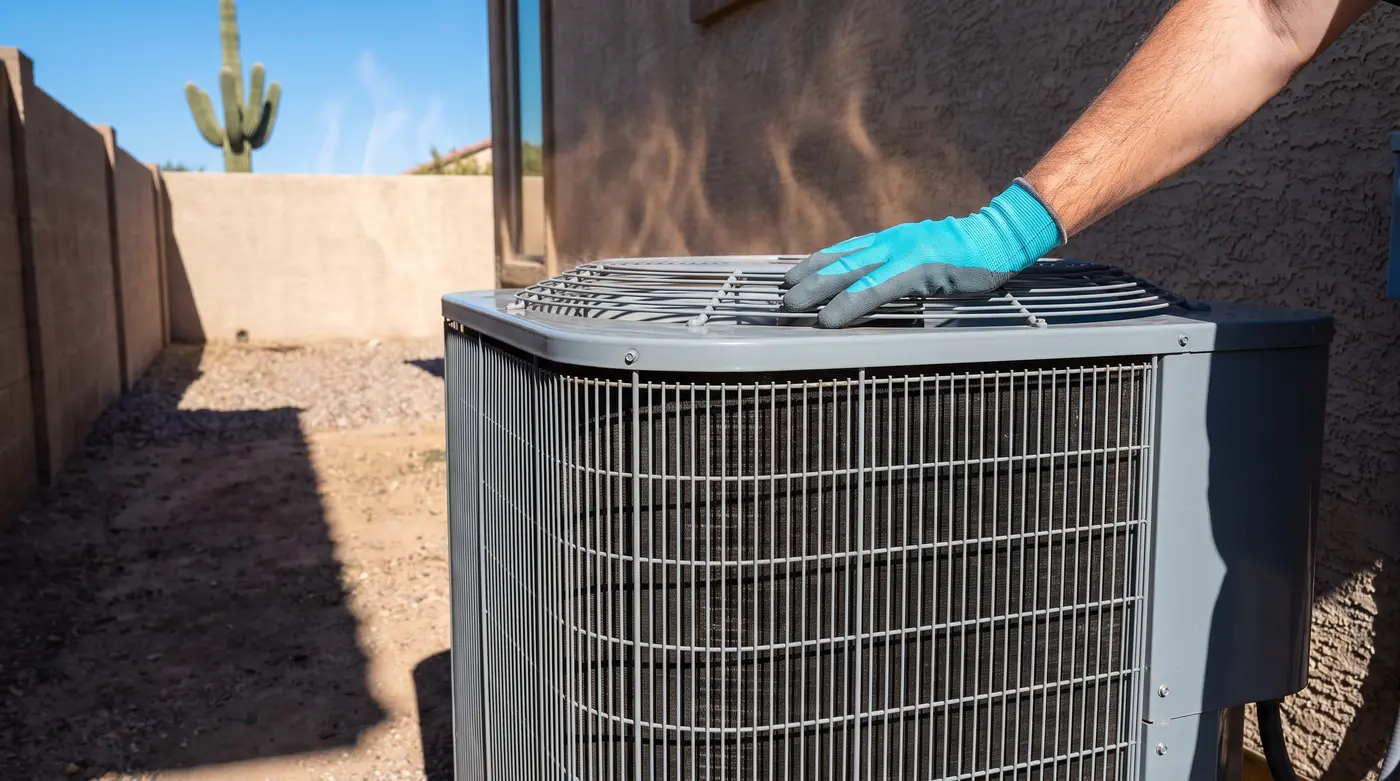
- Outdoor unit. Walk out and look. Clear palm fronds, haboob debris, or a trash can pressed against the fins. Listen for the fan. Do not open any panel.
What it usually means
An outdoor unit that hums but will not start, a fan that runs while the house creeps upward, a system that shuts off after two minutes: these are the ordinary failures of a Phoenix summer, and most of them are ordinary repairs. Our AC not cooling page walks through the common causes if you want to understand what the technician is looking for. The failure itself is rarely the danger. The danger is time. A block-and-stucco tract home with west-facing glass and a 155-degree attic above it gains heat fast once the compressor quits, and by late afternoon the inside of the house can sit above 90 degrees with no air moving. That is the condition this page exists for.Who is most at risk
Heat is hardest on people who cannot regulate it well or cannot get away from it on their own. Infants and small children. Adults over 65. Anyone pregnant. Anyone with a heart, lung, or kidney condition, or who takes medication that affects hydration or sweating. Anyone who works outdoors and comes home to a hot house. People with limited mobility who cannot easily move to a cooler room or a car. And pets, especially short-nosed dogs. If someone in your house fits this list, the repair timeline is not the question. The question is whether they should still be in the house.Plain signs of heat trouble
This is general safety information, not medical advice. The early signs are the ones people talk themselves out of: heavy sweating, cramps in the legs or stomach, headache, dizziness, nausea, feeling unusually tired or irritable. Those signs mean get the person cooler now. The serious signs are a high body temperature, hot skin that may have stopped sweating, confusion, slurred speech, fainting, or a person who cannot be roused. Those signs are an emergency. Call 911. Do not wait for us, and do not put a confused person in a car and drive them yourself unless dispatch tells you to.Cooling strategies while you wait
Slow the house down and cool the people, in that order of effort but the reverse order of importance.- Close everything on the west and south. Blinds, curtains, blackout panels, a bedsheet taped over the glass if that is what you have. West-facing windows are the biggest heat source in a Valley home after 2 p.m.
- Move to the coolest room. Usually a north-facing room on the ground floor, away from the kitchen. Shut the doors to rooms you are not using.
- Fans move air, not heat. A fan helps a sweating person cool, so point it at people. It does not lower the room temperature, and above roughly 95 degrees indoors a fan blowing hot air can make things worse.
- Water on skin. Cool showers, wet towels on the neck and wrists, a spray bottle. Evaporation is the point. Drink water steadily even if you are not thirsty. Skip alcohol.
- Do not cook. The oven and stovetop are heaters. So is the dryer.
- Use the car. A parked car with the engine running and the AC on is a legitimate cooling space for a short break. A parked car with the engine off is the opposite, and never a place to leave a child or a pet.
Stop and call if
Call us at (480) 863-5855 the moment the safe checks above fail. We run 24/7 same-day emergency AC repair across the Valley, and the technician quotes a flat rate before any work begins. When you call, tell the dispatcher three things: the age and type of the system if you know it, what you already checked, and whether anyone in the home is on the at-risk list above. That last item is not small talk. It changes how the call is prioritized.When to leave the house
Leave if the indoor temperature is climbing past the low 90s and you have an at-risk person with you. Leave if anyone shows the early signs and is not improving after twenty minutes of cooling. Leave if the repair cannot happen today for any reason. A friend's house, a library, a mall, a movie theater, a hotel for one night. Cooling centers exist across Maricopa County during heat warnings; the county and city websites list current locations and hours, and 211 can point you to the nearest one. Going somewhere cool for the afternoon is not overreacting. It is the plan.The honest part
Some failures during a heat warning are a capacitor and twenty minutes. Some are a compressor on a fourteen-year-old rooftop package unit, and that is a different conversation. If the technician tells you the repair is a large fraction of the system's value, ask for both numbers and read the repair-versus-replace guide before you decide. Nobody should make a five-figure decision at 4 p.m. in a 94-degree kitchen. Financing on approved credit exists precisely so that you do not have to. And once the house is cool again, put a spring maintenance visit on the calendar. Most of the calls we take during heat warnings started as small problems in April.When the AC Fails During a Heat Warning: common questions
Straight answers, no runaround. Don’t see yours? Our team is a phone call away, around the clock.
Usually not for long. Warm air from the vents often means the outdoor unit has stopped while the indoor blower keeps running, and in some cases the indoor coil is freezing. Switch the thermostat to OFF, set the fan to ON to keep air moving, and call. Our warm-air page covers the common causes.
It depends on orientation, insulation, and the time of day the system quit. A west-facing home that fails at noon on a 112-degree day can pass 90 degrees inside by evening and keep climbing overnight because the attic and walls release stored heat. Older homes with thin attic insulation heat faster. Treat any indoor reading in the 90s as a reason to move at-risk people out.
No. One reset is a reasonable check. A breaker that trips again is doing its job, and repeatedly forcing it can damage the compressor or worse. Leave it off and tell the dispatcher it tripped twice. The breaker page explains what a technician looks for.
They help people, not rooms. Air moving across damp skin speeds evaporation, which is how your body sheds heat. Aim fans at occupants rather than trying to circulate the whole house. Once indoor air climbs into the mid-90s, a fan can push hot air over you faster than you can cool, so at that point wet towels and a cooler location matter more.
Because it changes the order of the day. Dispatch works a queue, and a house with an infant or an 80-year-old in it is not the same call as a vacant rental. Tell us plainly. We would rather rearrange the schedule than find out afterward.
Healthy adults often can, with fans, open interior doors, and a cooler ground-floor room. At-risk occupants generally should not, particularly if the indoor temperature has not dropped below the upper 80s by bedtime. Overnight lows in July often stay above 90 outside, so the house will not cool much on its own. When in doubt, a hotel for one night is cheaper than the alternative.
It is a pattern worth taking seriously. Systems that fail under peak load two summers running are usually telling you something about their age, refrigerant charge, or airflow. A pre-season tune-up catches many of those, and if the unit is past its expected life, the repair-versus-replace math is worth doing in the fall rather than in an emergency.
No. We are an HVAC contractor. The signs listed here are general safety information, and the correct response to a serious sign such as confusion, fainting, or hot skin that has stopped sweating is to call 911. We will get the equipment running. The people are your first priority, and emergency services are theirs.
Emergency AC Repair throughout the Phoenix area
Same-day appointments across Maricopa and Pinal counties. Pick your city for local pricing pages, reviews and service details.
Get a Technician to the House Today
A web page cannot diagnose a dead compressor or a tripped safety. An on-site visit can. Call (480) 863-5855 or request same-day service, and tell dispatch about anyone who should not be in a hot house.
- 24/7 emergency service
- Upfront, honest pricing
- Licensed, bonded & insured